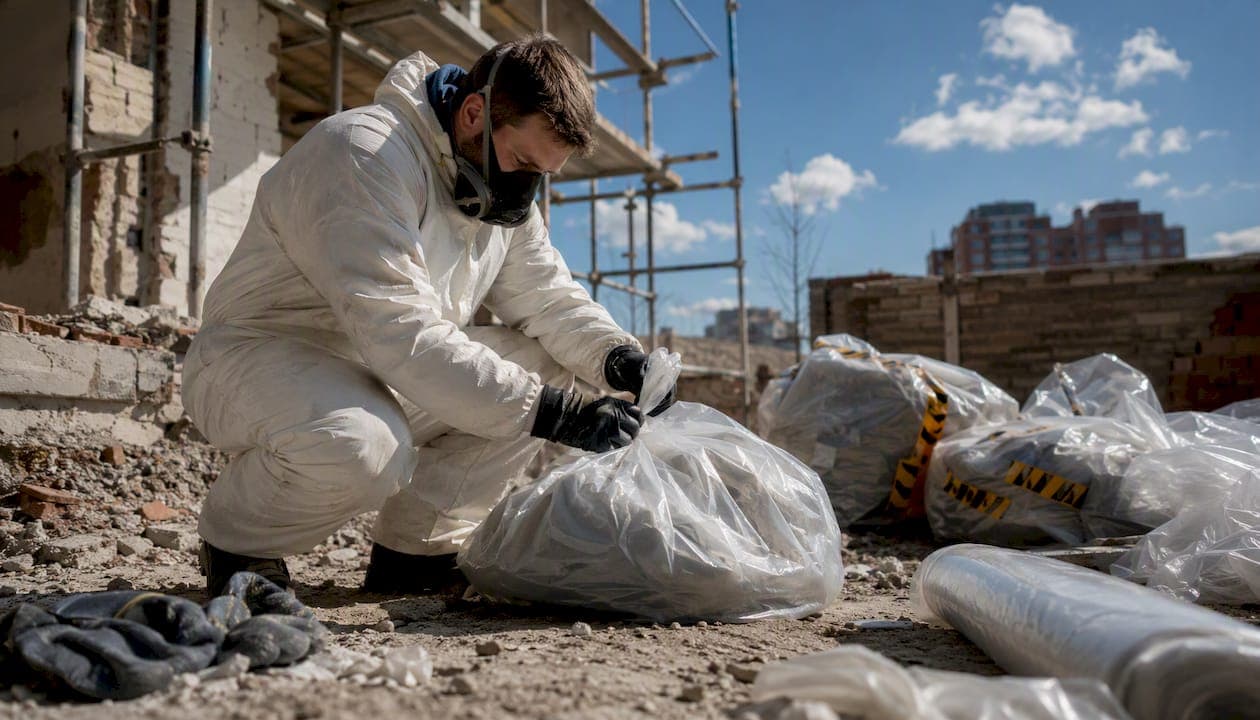
Stop work immediately, do not disturb the material, and arrange collection through a licensed carrier or your local hazardous-waste centre. That is the single correct first move whenever you discover or suspect asbestos. Everything else follows from it.
Here is what to do right now:
- Secure the area. Keep people away from the material and close off the space if possible.
- Stop all disturbance. Do not sweep, vacuum, sand, drill, or break anything near the suspect material.
- Do not use a domestic hoover. Standard vacuum cleaners spread fibres rather than contain them.
- Contact your local council's hazardous-waste service or use the GOV.UK postcode finder to locate your nearest authorised collection point.
- Find a licensed disposal site using the NORAC asbestos disposal map, which lists authorised reception points across the UK.
- Verify any carrier before handing over waste. The Environment Agency public register lets you confirm a carrier's registration in seconds. Binshare's platform cross-checks this automatically for every carrier on its network.
The HSE and Environment Agency are the primary regulatory bodies. Neither permits' asbestos waste to be placed in a general skip or domestic bin.
Key takeaways
Asbestos disposal in the UK is a legally regulated process: you must use a registered carrier, complete a Hazardous Waste Consignment Note, and retain records for three years.
| Point | Details |
|---|---|
| Stop and contain first | Do not disturb suspect material; secure the area and call a licensed contractor or council service before doing anything else. |
| Verify your carrier | Check the Environment Agency public register before booking; handing waste to an unregistered carrier is a criminal offence. |
| Package to HSE EM9 standard | Double-wrap in heavy-gauge polythene, red inner bag and clear outer, with correct UN labelling (UN2212 or UN2590). |
| Keep consignment notes for three years | Both waste producer and carrier must retain Hazardous Waste Consignment Notes; this is your legal protection if enforcement questions arise. |
| Binshare simplifies compliance | Binshare connects you with verified licensed carriers and provides digital duty-of-care receipts, reducing the administrative burden of compliant disposal. |
Table of Contents
- When does asbestos disposal in the UK require a licensed contractor?
- How to dispose of asbestos safely: step by step
- Transport rules, documentation, and duty of care
- Where can you legally take asbestos waste in the UK?
- What does asbestos disposal cost, and can councils take it for free?
- What are your legal duties, and what happens if you get it wrong?
- How to choose and verify a licensed asbestos removal or disposal service
- How Binshare helps you meet duty-of-care requirements
- Why verified disposal routes matter more than people realise
- Arrange compliant asbestos collection through Binshare
- Sources
When does asbestos disposal in the UK require a licensed contractor?
The Control of Asbestos Regulations 2012 draws a clear line between licensable and non-licensable work, and getting this wrong carries serious legal and health consequences.
Licensable work covers any activity that is liable to expose workers to asbestos fibres above a short-duration threshold. That includes removing thermal insulation from pipes or boilers, stripping sprayed coatings, disturbing loose-fill insulation in ceiling voids, and handling any friable (crumbly) asbestos-containing material. These jobs must be carried out by a contractor holding an HSE licence, and the work must be notified to the relevant enforcing authority before it starts.
Non-licensable work covers some bonded cement products, such as corrugated asbestos-cement roofing sheets or floor tiles, where the fibres are locked into a hard matrix and the risk of airborne release is lower. Even here, the work still falls under the Regulations and requires a written risk assessment, method statement, and appropriate PPE.
The practical rule is straightforward: if you are in any doubt, treat the material as licensable. The latency period for asbestos-related diseases such as mesothelioma typically runs to decades, which is why the HSE stresses that even small fibre releases from apparently minor jobs carry long-term risk.
Pro Tip: Ask any contractor to show their HSE licence number before work starts. Request a copy of their method statement, risk assessment, and proof of employer's liability insurance. When the job is complete, ask for the Hazardous Waste Consignment Note — this is your evidence that the waste left your property legally.
How to dispose of asbestos safely: step by step
The process differs slightly between a homeowner dealing with a small amount of bonded cement sheet and a business managing a larger commercial strip-out, but the legal framework is the same.
- Stop and assess. Identify the material type (bonded or fibrous), approximate quantity, and condition. If it is damaged or friable, stop immediately and call a licensed contractor.
- Contain the area. Lay polythene sheeting on the floor to catch any debris. Do not attempt to move damaged material without professional guidance.
- Put on PPE. At minimum: a disposable FFP3 respirator, disposable coveralls (Type 5/6), and nitrile gloves. Ordinary dust masks are not adequate.
- Wet down the material lightly before handling to suppress dust. Do not soak it.
- Package carefully. HSE EM9 guidance specifies double-wrapping in heavy-gauge polythene (at least 500 microns). Use a red inner bag and a clear outer bag. Seal all seams with tape. Do not break large panels — wrap them whole. Attach the correct UN label (UN2212 for raw asbestos, UN2590 for asbestos waste in articles).
- Label the package clearly as asbestos waste, including your name, address, and the date of packaging.
- Arrange a licensed carrier. You cannot legally transport most asbestos waste yourself without meeting specific carriage requirements. Book a registered waste carrier and confirm the receiving site will accept the material before collection.
- Complete the Hazardous Waste Consignment Note (or Special Waste Consignment Note in Scotland). Keep your copy for at least three years.
- For commercial or large-scale jobs: pre-notify the Environment Agency (or SEPA/DAERA in Scotland/Northern Ireland) where required, and confirm site acceptance in writing before transport.
Pro Tip: Never cut corrugated asbestos-cement sheets to make them fit a bag. Cutting releases fibres. Wrap the full sheet in polythene, tape it securely, and arrange a carrier that can handle the full dimensions.
Transport rules, documentation, and duty of care
You must use a registered waste carrier for asbestos waste, and both you and the carrier must complete the correct paperwork. The HSE carriage guidance explains that asbestos waste containing more than 0.1% asbestos is classified as hazardous (or special waste in Scotland), which triggers the full documentation chain.
Documents and checks required:
- Waste carrier licence (check the Environment Agency public register before booking)
- Hazardous Waste Consignment Note (England, Wales, Northern Ireland) or Special Waste Consignment Note (Scotland)
- Site acceptance confirmation from the receiving facility
- ADR driver training certificate where the load meets carriage thresholds
- Proof of packaging compliance (UN-approved packaging where required)
The table below sets out the two UN numbers that apply to asbestos waste in transport:
| UN number | Waste type | Typical carriage documentation trigger |
|---|---|---|
| UN2212 | Raw asbestos fibres (amphibole or chrysotile) | Required for any quantity above ADR exemption thresholds |
| UN2590 | Asbestos waste in articles (bonded products, cement sheets, tiles) | Required when the mixed-load ADR threshold calculation is met |
When a load contains both transport categories, the HSE ADR threshold formula applies: multiply the Category 2 material weight by three, add the Category 3 weight, and if the total exceeds 1,000 kg, full carriage documentation is required.
Pro Tip: Always call the receiving site before loading the vehicle. Confirm the material type, approximate weight, and packaging format. Some transfer stations accept only bonded asbestos; others will take fibrous insulation if it is correctly packaged. A rejected load wastes time and may leave you with unsecured waste on a vehicle.
Where can you legally take asbestos waste in the UK?
Recycle Now confirms that asbestos cannot be recycled or reused, so the only legal routes are authorised disposal facilities. Here is where to look:
- Local council hazardous-waste centre: Many councils in England and Wales accept small domestic quantities at designated household waste recycling centres (HWRCs). Use the Gov to check what your council accepts. Eligibility varies — some councils limit quantities or restrict access to residents only, and commercial waste is almost never accepted at HWRCs.
- Licensed hazardous-waste transfer station: These accept larger quantities from both domestic and commercial sources. Confirm the site holds a current permit using the Environment Agency waste operations register.
- Permitted landfill: A small number of licensed landfill sites in the UK are permitted to accept asbestos waste. Pre-notification is standard practice, and not all landfills accept every type.
- NORAC disposal map: The NORAC map is the most practical starting point for finding a licensed reception point near you. Sites vary in what they accept, so always confirm before travelling.
- Scotland: Contact SEPA for region-specific guidance on special waste disposal.
- Northern Ireland: DAERA provides hazardous-waste guidance specific to NI residents and businesses.
Call before you drive. Confirm the weight limit, material type, packaging format, and any pre-notification requirement. A phone call takes two minutes; a rejected load can take hours to resolve.
What does asbestos disposal cost, and can councils take it for free?
Cost depends on several variables, and the range is wide. A recent industry price guide from The Waste Group gives indicative per-kilogram and per-load figures used by industry commentators, though regional variation means quotes can differ significantly.
The main cost factors are:
- Waste type: Bonded cement products (lower risk, lower cost) versus fibrous or friable insulation (higher risk, higher cost).
- Volume and weight: Disposal is typically priced per kilogram or per load. Small domestic amounts cost less than commercial strip-outs.
- Packaging: If you need the carrier to supply UN-approved packaging, that adds to the total.
- Transport and carrier fees: Distance to the nearest licensed site and the carrier's own rates.
- Site acceptance charges: The receiving facility charges a gate fee, which varies by site and material type.
Some councils do accept small domestic quantities at HWRCs at no charge, but this is not universal. Many limit the amount to a few sheets of cement board, and commercial waste is excluded. Always check with your council directly before assuming free disposal is available.
When requesting quotes, ask for an itemised breakdown covering packaging, consignment note preparation, carriage, and site acceptance. A single lump-sum quote makes it difficult to verify compliance and compare providers fairly.
What are your legal duties, and what happens if you get it wrong?
Under the duty of care for waste producers, you are legally responsible for ensuring asbestos waste is handled, transported, and disposed of correctly from the moment it leaves your property. That responsibility does not transfer to the carrier simply by handing over the waste.
Key legal obligations:
- Retain Hazardous Waste Consignment Notes for at least three years. This applies to both the waste producer and the carrier.
- Use only registered waste carriers. Handing waste to an unregistered carrier is a criminal offence under the Environmental Protection Act 1990.
- Comply with the Control of Asbestos Regulations 2012 for any removal or disturbance work.
- Follow Hazardous Waste Regulations (England and Wales) or Special Waste Regulations (Scotland) for classification, documentation, and movement.
Enforcement sits with the Environment Agency in England, Natural Resources Wales in Wales, SEPA in Scotland, and DAERA in Northern Ireland. Penalties range from fixed-penalty notices through to unlimited fines and imprisonment for serious or repeat offences. Fly-tipping asbestos is treated particularly harshly: it combines a hazardous-waste offence with an environmental crime, and prosecutions are not uncommon.
Proper paperwork is your best protection. A complete consignment note trail shows regulators that you took reasonable steps, which materially reduces enforcement risk even when something goes wrong downstream.
How to choose and verify a licensed asbestos removal or disposal service
The single most important step is to check before you book, not after.
- Check the Environment Agency public register at the waste carriers, brokers and dealers search to confirm the carrier is registered. A legitimate carrier will give you their registration number without hesitation.
- Confirm the disposal site's permit using the waste operations register. The site must be permitted to accept asbestos waste specifically.
- Ask for the contractor's HSE licence if removal work is involved. Licensable work requires a current HSE asbestos licence, not just a waste carrier registration.
- Request proof of ADR driver training where the load triggers carriage documentation requirements.
- Ask for insurance details: public liability and employer's liability as a minimum.
- Get a written estimate that itemises packaging, carriage, consignment note handling, and site fees separately.
Red flags to watch for:
- Refuses to provide a consignment note or says it is "not necessary."
- Suggests using a general skip or mixed-waste collection.
- Cannot provide a carrier registration number or HSE licence on request.
- Offers a price that seems implausibly low for the scope of work.
- Asks for cash only with no written record.
Any one of these should end the conversation. The consequences of using an unlicensed carrier fall on you as the waste producer.
How Binshare helps you meet duty-of-care requirements
Using a verified marketplace removes much of the administrative friction from asbestos waste management UK compliance. Binshare connects homeowners and businesses with licensed waste carriers whose Environment Agency credentials are checked before they join the platform.
Specific benefits for asbestos and hazardous waste collection:
- Verified carrier credentials: Every carrier on Binshare is checked against Environment Agency registration requirements, so you are not relying on a self-declaration.
- Photo upload for accurate quoting: Upload a photo of the packaged waste so carriers can bid accurately, reducing the risk of price surprises on collection day.
- Competitive bids: Multiple licensed carriers respond to your job, which tends to bring costs down compared with calling a single provider.
- Digital duty-of-care receipts: Binshare generates a digital record of the collection and payment, supporting the consignment note trail you are legally required to retain.
- Secure in-app payment: Payment is held and released after collection, protecting both parties.
For small businesses and homeowners who find the paperwork side of asbestos waste management daunting, having a platform that handles carrier verification and produces a digital audit trail is a practical compliance shortcut.
Why verified disposal routes matter more than people realise
The temptation with a small amount of asbestos-cement sheeting is to treat it as a minor inconvenience rather than a regulated hazardous material. That instinct is understandable but genuinely dangerous, and not just in the obvious physical sense.
The legal exposure for a homeowner who hands asbestos to an unregistered carrier is the same as for a business. Duty of care does not scale with the size of the job. What changes with scale is the likelihood of enforcement attention, but the liability is identical. A single consignment note kept for three years costs nothing and closes that exposure completely.
The other thing people underestimate is how much the verification step matters when choosing a carrier. The public registers exist precisely because the market for waste collection includes operators who will take your money, dump the material illegally, and leave you holding the legal consequences. Checking a registration number takes thirty seconds. Not checking it can take considerably longer to resolve.
Arrange compliant asbestos collection through Binshare
Sorting licensed asbestos collection does not have to mean hours of phone calls and paperwork uncertainty. Binshare connects you directly with verified, licensed waste carriers who handle hazardous waste collections across the UK, with digital duty-of-care receipts included as standard.
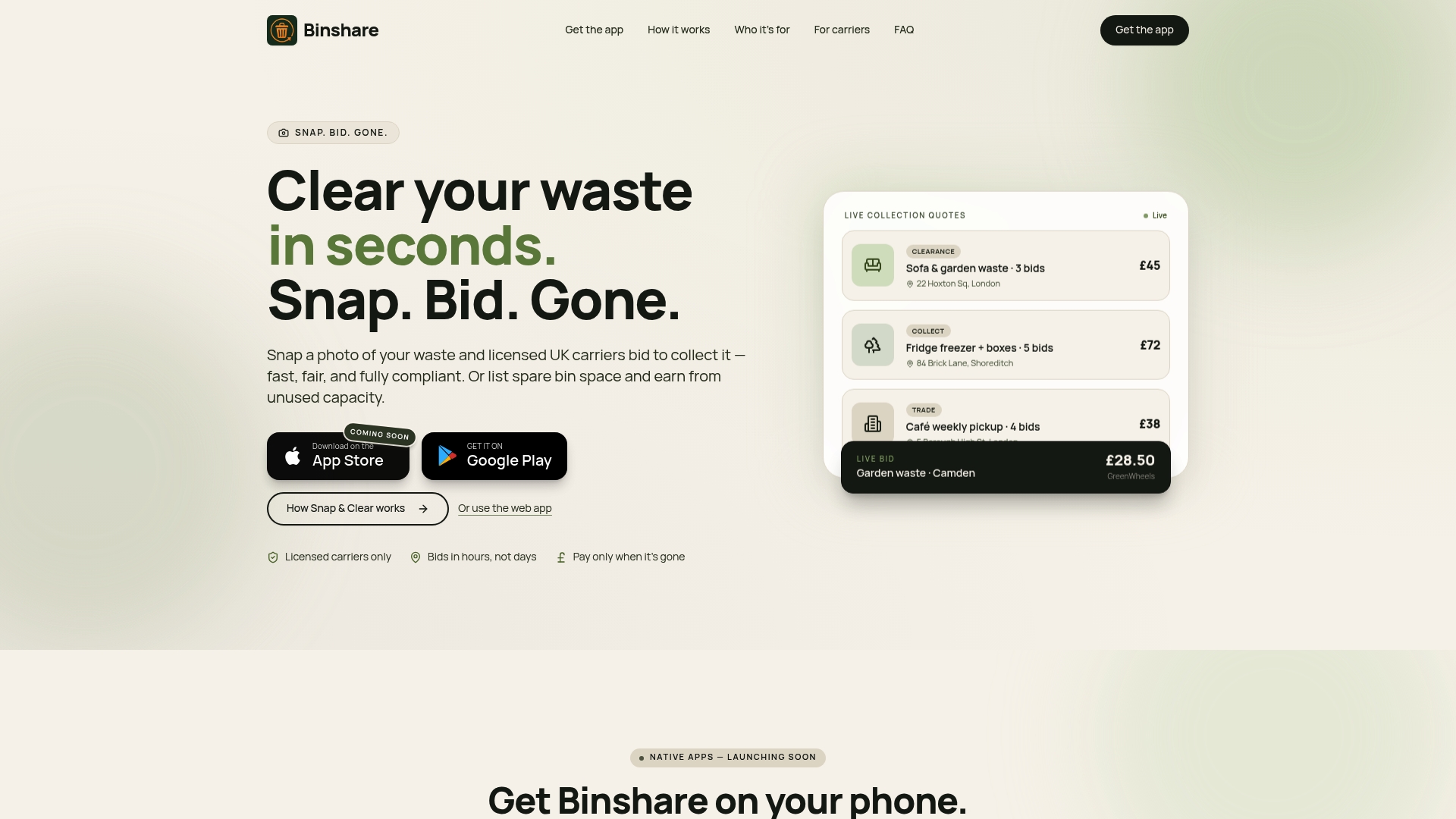
Upload a photo of your packaged waste, receive competitive bids from carriers whose Environment Agency credentials have already been checked, and pay securely once the collection is confirmed. Every completed job generates a digital consignment record you can retain for your three-year duty-of-care obligation. No chasing paperwork, no uncertainty about whether your carrier is registered.
Book a collection or get a quote via Binshare and have a verified carrier arranged quickly, with full compliance documentation handled through the platform.
Sources
This article is general information, not a substitute for advice from a qualified doctor. Consult a qualified healthcare professional about your own circumstances before acting on anything here.