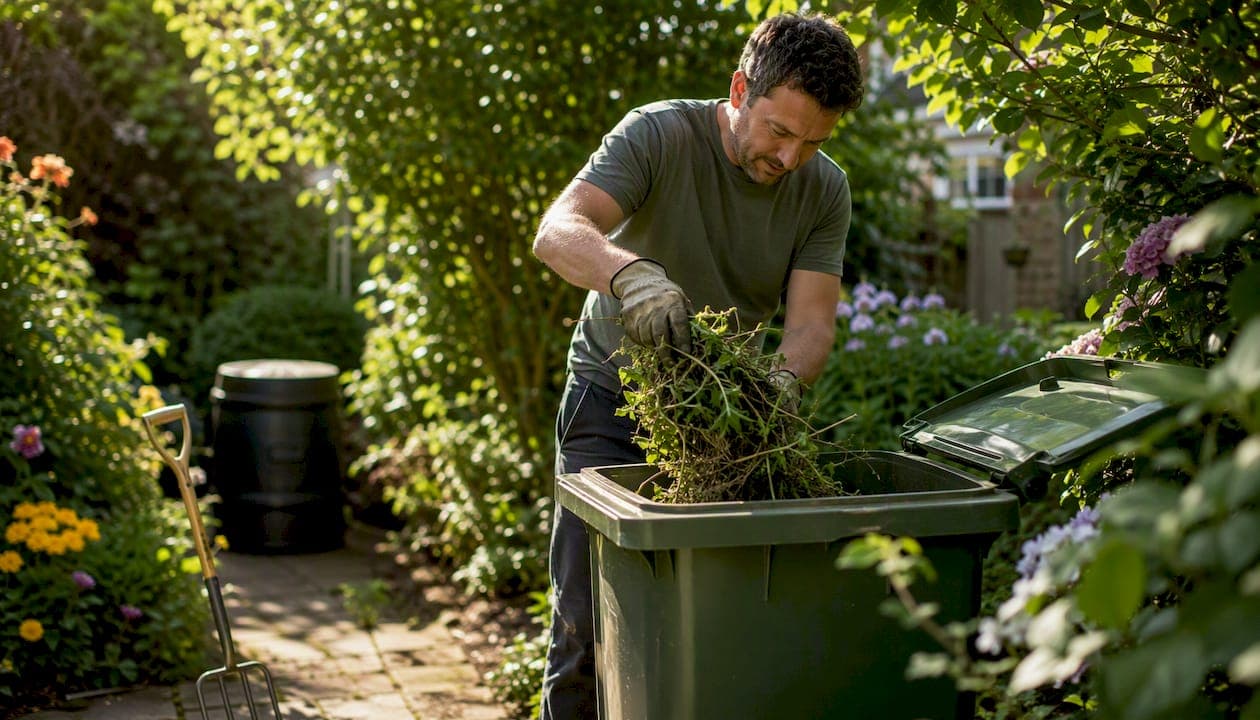
Expect to pay around £180 for a typical independent van collection, though the actual garden waste removal cost varies considerably depending on volume, waste type and where you live. Council subscription schemes are usually the cheapest legal route, often costing about £55 per year or sometimes free. Skip hire typically costs about £250. A professional garden clearance team usually charges between £45 and £60 per hour.
Typical prices at a glance:
- Council kerbside collection: free to approximately £55 per year (subscription)
- Independent van removal: between £80 and £400, averaging around £180
- Skip hire (small to medium): between £150 and £400, averaging about £250
- Garden clearance team: charges typically fall between £45 and £60 per hour or £150 to more than £500 per job
| Method | Typical range | Rough average |
|---|---|---|
| Council collection | Free–£55/year | ~£55/year |
| Van removal | £80–£400 | ~£180 |
| Skip hire | £150–£400 | ~£250 |
| Clearance team (hourly) | £45–£60/hr | ~£52/hr |
Key takeaways
Garden waste removal in the UK costs anywhere from free (council collection) to several hundred pounds for a large clearance, and the method you choose matters more than almost any other variable.
| Point | Details |
|---|---|
| Council collection is cheapest | Annual subscriptions average ~£55/year; ideal for regular clean green waste. |
| Van removal suits one-off jobs | National average is ~£180; get a photo quote for the most accurate price. |
| Soil and mixed waste cost more | Weight-based disposal fees apply; declare mixed materials upfront to avoid surcharges. |
| Composting cuts costs significantly | Composting reduces green-waste volume by roughly 50–75%, lowering collection frequency. |
| Binshare for fast, verified pickups | Photo quotes, Environment Agency-verified carriers and digital duty-of-care receipts in one app. |
Table of Contents
- How much does garden waste removal cost in the UK?
- What actually counts as garden waste in the UK?
- Which removal method suits you, and what does each cost?
- What drives the price up or down?
- Sample jobs: what would your clearance actually cost?
- How to prepare your waste and what to ask every provider
- Sustainable ways to cut your garden waste removal costs
- Why compliant disposal matters more than most people realise
- Binshare makes verified garden waste collection straightforward
- Sources
How much does garden waste removal cost in the UK?
The figures above come from national cost guides that track what UK homeowners actually pay, and they tell a consistent story: method matters far more than geography when it comes to the headline price. That said, regional variation is real.
| Method | Low end | High end | Typical average | Best for |
|---|---|---|---|---|
| Council collection | Free | Up to about £75 per year | Around £55 per year | Regular green waste, routine clippings |
| Van removal | £80 | £400 | Around £180 | One-off loads, mixed light waste |
| Skip hire (2–4 yd³) | £150 | £400 | Around £250 | DIY clearances, larger volumes |
| Clearance team | £45/hr | £60/hr | About £52 per hour | Overgrown gardens, heavy labour |
| Per-load clearance | £150 | Over £500 | Around £300 | Medium to large one-off jobs |
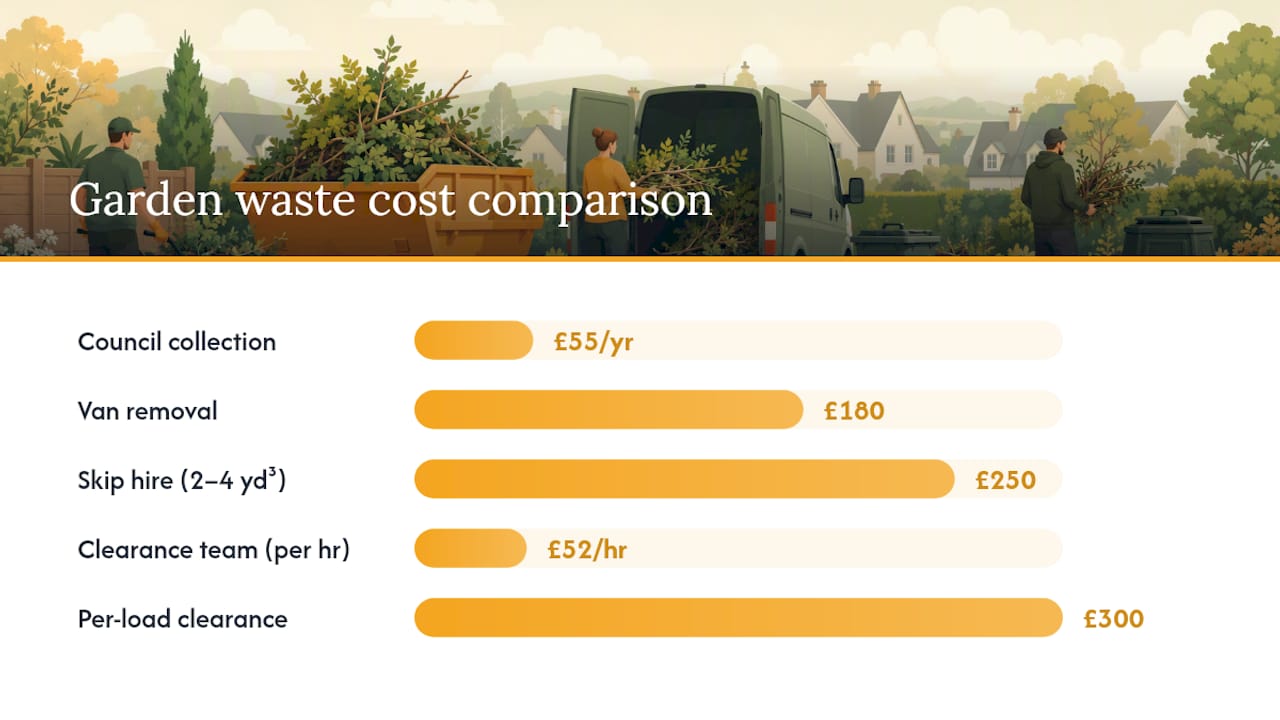
London and the South East consistently sit above these national averages. Costwise's regional analysis puts a medium overgrown garden clearance at around £300 nationally, but that figure climbs noticeably in the capital. Conversely, prices in the North of England, Scotland and Wales tend to run below the national midpoint, partly because labour rates and tipping fees are lower. Always check your local council page for precise subscription costs, since each council sets its own fee structure and accepted items.
What actually counts as garden waste in the UK?
Not everything from your garden qualifies as "green waste," and the distinction matters because it changes both the disposal route and the price.
Accepted as standard green waste by most councils and carriers:
- Grass cuttings and lawn clippings
- Leaves and leaf mould
- Hedge and shrub prunings
- Soft plant stems and dead flowers
- Small branches (usually up to a set diameter)
- Weeds (non-invasive species)
Commonly excluded or subject to surcharges:
- Soil and turf (heavy, charged by weight)
- Rubble, concrete and hardcore
- Treated or painted timber
- Plastic plant pots and trays
- Japanese knotweed and other invasive species (require specialist disposal)
- Food waste (separate collection stream)
Soil is the item that catches most people out. A barrow-load of topsoil weighs far more than the same volume of prunings, and many carriers charge by weight for it. Treated timber cannot go to a composting facility, so it moves into a different waste category with higher disposal fees. Gov confirms that councils set their own rules on accepted items, so what your neighbour's council takes may differ entirely from yours.
As a householder, you also carry a legal duty of care: you are responsible for ensuring your waste is disposed of properly, even when you hire someone else to do it. That means using a licensed waste carrier and keeping proof of disposal.
Which removal method suits you, and what does each cost?
Council kerbside collection
Most councils offer a garden-waste collection service, either as part of the standard refuse round or as a paid subscription. Where it exists, this is almost always the cheapest option for routine green waste. You put out a brown or green bin on collection day and the council handles the rest. The catch is that many councils only accept clean green waste, collections are fortnightly at best, and the bin size limits how much you can shift at once.
GOV.UK confirms that each council sets its own fees, accepted items and service frequency, so check your local authority's website before assuming the service is available or free.
Independent van removal
A licensed carrier arrives, loads your waste into their vehicle and takes it to a licensed facility. This is the most flexible one-off option: you can book at short notice, the carrier does the loading, and you get a duty-of-care transfer note as proof of legal disposal. Costs typically run £80–£400 depending on volume, with the national average around £180. Heavier or mixed loads push the price up because tipping fees at licensed facilities are higher for non-green waste.
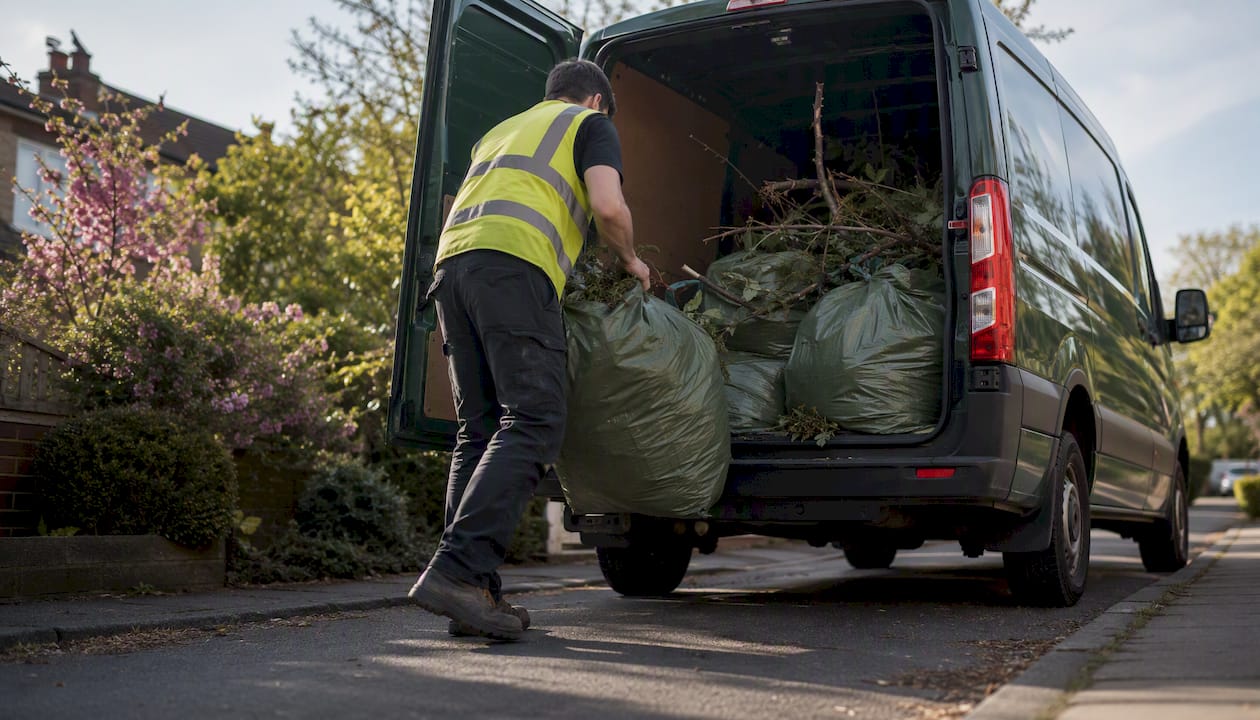
Pro Tip: Photograph your waste pile before booking. Most carriers and marketplace platforms can give you a much more accurate quote from a photo than from a verbal description of "a few bags of prunings."
Skip hire
You hire the skip, fill it yourself and the company collects it. A 2-yard mini-skip suits a small tidy-up; a 4-yard midi-skip handles a medium clearance. Prices average around £250 but vary by size and region. If the skip needs to sit on a public road, you need a council permit, which adds to the cost and requires advance planning. Trade guidance from BookaBuilderUK notes that soil and hardcore are often charged by weight on top of the base hire fee, which can make a seemingly cheap skip considerably more expensive once the lorry is weighed.
For one-off large clearances, a properly sized skip is often cheaper if you can load it yourself. If you need labour on top of disposal, a clearance team may be the more efficient option despite higher headline rates.
Garden clearance teams
A crew arrives, does the physical work and removes the waste. Hourly rates sit around £45–£60, and most teams give a per-job quote for larger clearances. Labour is the biggest single cost here. A small tidy-up might take one person two hours; a heavily overgrown plot with shed removal and soil disposal can run to a full day for two people, plus disposal fees on top. This route suits anyone who cannot do the loading themselves or who has a genuinely complex job with mixed materials.
What drives the price up or down?
Understanding these variables lets you get accurate quotes and avoid surprises on collection day.
- Volume: the single biggest lever. More waste means more trips or a larger skip.
- Weight: soil, turf and rubble are charged by weight at licensed facilities. A load that looks modest can be expensive if it is mostly earth.
- Waste type: clean green waste is cheapest to dispose of. Mixed loads, treated timber or invasive species all attract higher disposal fees.
- Access: a carrier who cannot get a vehicle close to your garden will charge more for the extra labour, or may decline the job.
- Preparation: sorted, bagged or stacked waste is quicker to load and often cheaper. Unsorted mixed piles take longer and may be reclassified as general waste.
- Distance and tipping fees: carriers in rural areas may charge a travel supplement; tipping fees at licensed facilities vary by region and waste type.
- Regional labour rates: London and the South East carry a premium; the North, Scotland and Wales tend to be cheaper.
- Skip permits: a skip on a public road requires a council permit, typically £25–£75 depending on the local authority.
Hidden fees to watch for: overfill charges if waste exceeds the skip's fill line; heavy-waste surcharges for soil or concrete; cancellation fees if you need to rebook; and weight-based disposal charges that are not included in the headline quote.
One non-negotiable: verify that your carrier holds a valid waste carrier licence from the Environment Agency. Using an unlicensed carrier leaves you legally liable if the waste is fly-tipped.
Sample jobs: what would your clearance actually cost?
A medium seasonal clearance is where most homeowners sit. Two or three barrow-loads of prunings, leaves and clippings fills roughly a 2-yard skip or one van load. At the national average of £180 for a van collection, that is a reasonable benchmark. Add soil or a shed, and you are looking at a large job: Costwise's analysis puts a medium overgrown garden clearance at around £300, with labour typically accounting for the larger share of that figure once disposal fees are separated out.
For large jobs, the labour-versus-disposal split is worth understanding. A clearance team charging £52/hour for two people over six hours costs around £624 in labour alone, before disposal. A midi-skip at £250 plus your own loading time may be cheaper if the job is physically manageable. BookaBuilderUK's trade breakdown confirms that labour is the dominant cost on most clearances, which is why getting the method right matters as much as getting the price right.
How to prepare your waste and what to ask every provider
Getting comparable quotes and avoiding last-minute surprises comes down to preparation and the right questions.
- Sort green from mixed waste. Separate clean green waste (prunings, clippings, leaves) from soil, timber and any non-organic material before anyone arrives. Mixed loads cost more to dispose of.
- Bag or stack where practical. Bagged or neatly stacked waste loads faster, which reduces labour time and often the final bill.
- Estimate your volume. A standard wheelie bin holds roughly 240 litres. Count your barrow-loads or bin-equivalents and note it when requesting quotes.
- Photograph the pile. A clear photo from two angles gives any provider enough information to quote accurately without a site visit. This is the single fastest way to get a realistic price.
- Note access constraints. Is there a gate width restriction? Steps? Parking limitations? Mention these upfront.
Questions to ask every provider:
- Can you show me your Environment Agency waste carrier licence number?
- Do you accept soil, turf or plant pots, and if so, how are they charged?
- What is your policy on overfill or unexpected heavy materials?
- Where does the waste go, and will I receive a duty-of-care transfer note?
- What is your turnaround time from booking to collection?
A provider who cannot answer the licence question clearly is one to avoid.
Sustainable ways to cut your garden waste removal costs
The cheapest option of all is reducing how much waste you need to remove in the first place. For routine clippings and prunings, home management is both the most cost-effective and the lowest-carbon route.
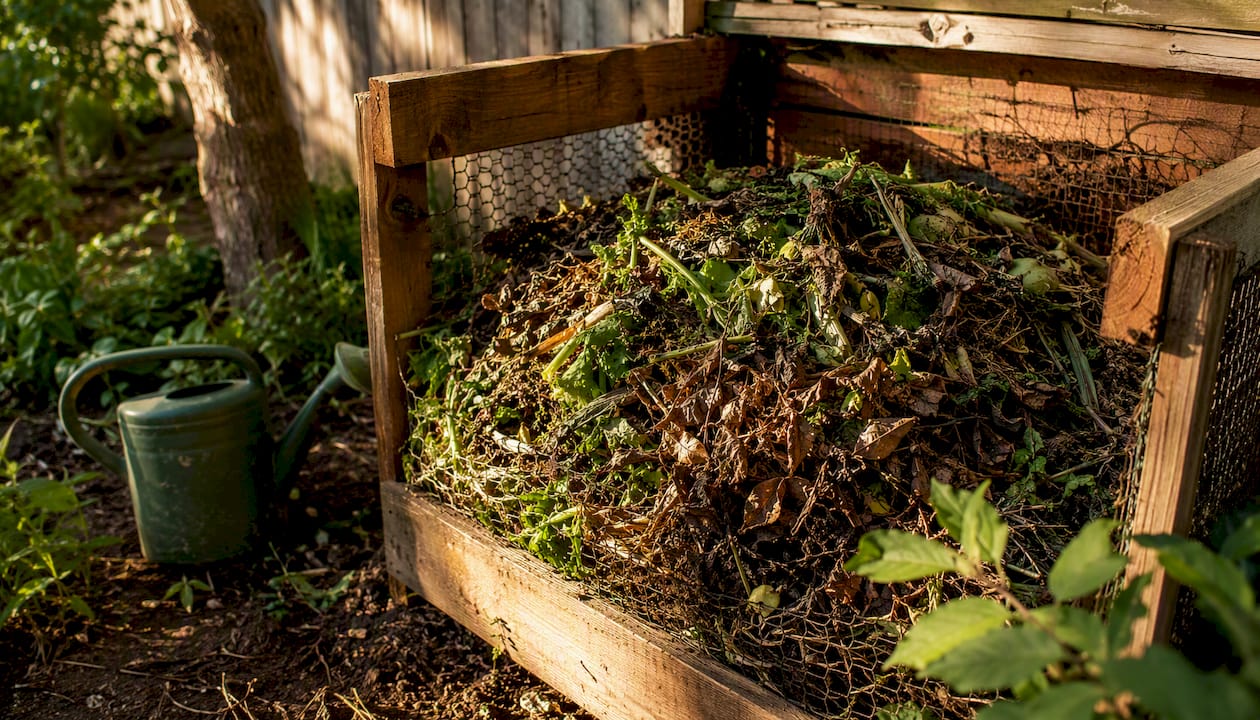
The RHS recommends composting and mulching as the primary approach for managing routine green waste at home, noting that it cuts disposal costs and transport emissions. A mulching lawnmower returns clippings directly to the lawn, eliminating the need to collect them at all. Prunings from soft-stemmed plants can go straight onto a compost heap; woody material can be chipped and used as path mulch or border dressing.
Composting can reduce your green-waste volume by roughly 50–75%. For a household generating regular garden waste, that reduction can cut the frequency of paid collections significantly, or eliminate them for routine maintenance entirely.
The practical limit is large clearances. Composting a season's worth of clippings is realistic; composting the contents of an overgrown half-acre is not. For those jobs, volume reduction still helps: chipping woody waste before disposal means it compresses better in a skip or van, reducing the number of loads. Turf lifted during landscaping can be stacked grass-side-down and left to rot into loam, avoiding disposal costs entirely.
One note on food-garden compost: compost made from kitchen scraps alongside garden waste should not be used on edible crops unless you are confident the inputs are safe. Stick to plant-only material for vegetable-bed compost.
Why compliant disposal matters more than most people realise
The temptation to use the cheapest quote without checking credentials is understandable, but the consequences of getting it wrong fall on you as the householder. If a carrier dumps your waste illegally, you can be held liable under the Environmental Protection Act 1990, even if you paid someone else to handle it. That is not a theoretical risk: fly-tipping enforcement has increased, and councils do pursue householders who cannot produce a duty-of-care transfer note.
Photo quotes have changed the market in a useful way. When a carrier can see exactly what they are collecting before they arrive, there are fewer disputes about load composition, fewer rejected collections and fewer surprise surcharges. The same photo that gets you an accurate quote also creates a record of what was collected, which supports your duty-of-care position.
Verified carriers matter for a second reason: they are registered with the Environment Agency, which means they are accountable for where the waste goes. An unregistered "man with a van" may be cheaper on the day, but the waste often ends up fly-tipped, and the saving is not worth the legal exposure.
Binshare makes verified garden waste collection straightforward
Getting a fast, compliant garden waste collection used to mean ringing round several firms, hoping they were licensed and waiting days for a quote. Binshare changes that: snap a photo of your waste, upload it to the platform and receive competitive bids from verified, Environment Agency-registered carriers within minutes.

Every carrier on Binshare holds a verified waste carrier licence, and every completed collection generates a digital duty-of-care receipt, so you have proof of legal disposal without chasing paperwork. Payments are handled securely in-app, and you only pay once the collection is confirmed. For homeowners with spare bin or skip space, Binshare also lets you list that capacity for neighbours to use, turning unused space into a small income stream.
The platform suits one-off clearances and regular collections alike, and it is particularly useful for mixed or complex loads where getting an accurate quote quickly matters. Book your collection on Binshare and have verified bids in your inbox today.
Sources
- Dispose of garden waste
- How to Deal with Garden Waste | RHS Advice
- Composting yard waste
- Garden Waste Removal Cost Guide 2026 | UK Prices
- Garden clearance cost calculator 2026 | Costwise
- Bookabuilderuk
Always check your local council's own website for precise subscription fees, accepted items and collection dates, as these differ by district and change periodically.