
For most UK household moves, a verified marketplace booking or a licensed man-and-van service is the fastest, safest way to clear moving-day rubbish. Before you book anything, check two things: the contractor's Environment Agency waste carrier registration and a Waste Transfer Note or digital duty-of-care receipt after collection. Miss either, and you carry legal liability if the waste is fly-tipped, regardless of who drove the van.
The quickest route right now: snap a photo of your waste, post it on Binshare to receive competitive bids from verified carriers, and confirm the carrier's registration number before you accept.
- Legal check 1: Environment Agency waste carrier registration — ask for the number and cross-check it on the public register before booking.
- Legal check 2: Waste Transfer Note or digital duty-of-care receipt — request this after collection and keep it.
Pro Tip: Snap photos of every room's worth of rubbish before you post a job. Accurate photos mean more accurate bids and fewer surprises on collection day.
Key takeaways
For moving house rubbish removal in the UK, verifying your carrier's Environment Agency registration and keeping a Waste Transfer Note are the two non-negotiable legal steps, regardless of which service you choose.
| Point | Details |
|---|---|
| Verify before you book | Always check the carrier's Environment Agency registration number on the public register before confirming. |
| Get a Waste Transfer Note | Request a digital or paper duty-of-care receipt after collection and keep it for at least two years. |
| Stage regulated items separately | Fridges, asbestos, paint, and gas bottles need specialist disposal routes — sort them before the crew arrives. |
| Match service to your timeline | Same-day need: use a verified marketplace or man-and-van. 48+ hours: skip hire or house clearance may cost less. |
| Use Binshare for speed and compliance | Binshare provides verified carriers, digital receipts, and competitive bids, often within minutes of posting a job. |
Table of Contents
- Which removal option fits your house move?
- What does moving house rubbish removal actually cost in the UK?
- What will a crew take, and what gets left behind?
- What happens when you book: timeline and collection day
- The UK legal checks you must make before booking
- How to choose the right provider for moving day
- How Binshare works for moving-house rubbish removal
- The moving-day mistakes most householders make
- Binshare: verified, fast rubbish removal for your move
- Sources
Which removal option fits your house move?
Five main routes exist for house moving waste disposal, and the right one depends on how much you have, how fast you need it gone, and how much effort you want to put in.
Marketplace pickup (peer-to-peer aggregator) connects you with local licensed carriers who bid for your job. You post a description or photo, receive quotes, and book the best offer. Speed is the main draw: bids can arrive within minutes, and same-day collection is often available. Binshare operates exactly this model, with built-in carrier verification and digital receipts.
Man-and-van clearance is the traditional option: a crew arrives, loads everything, and takes it away. Pricing is usually per load or per hour. Good for urgent, heavy, or awkward items where you need hands on the job.
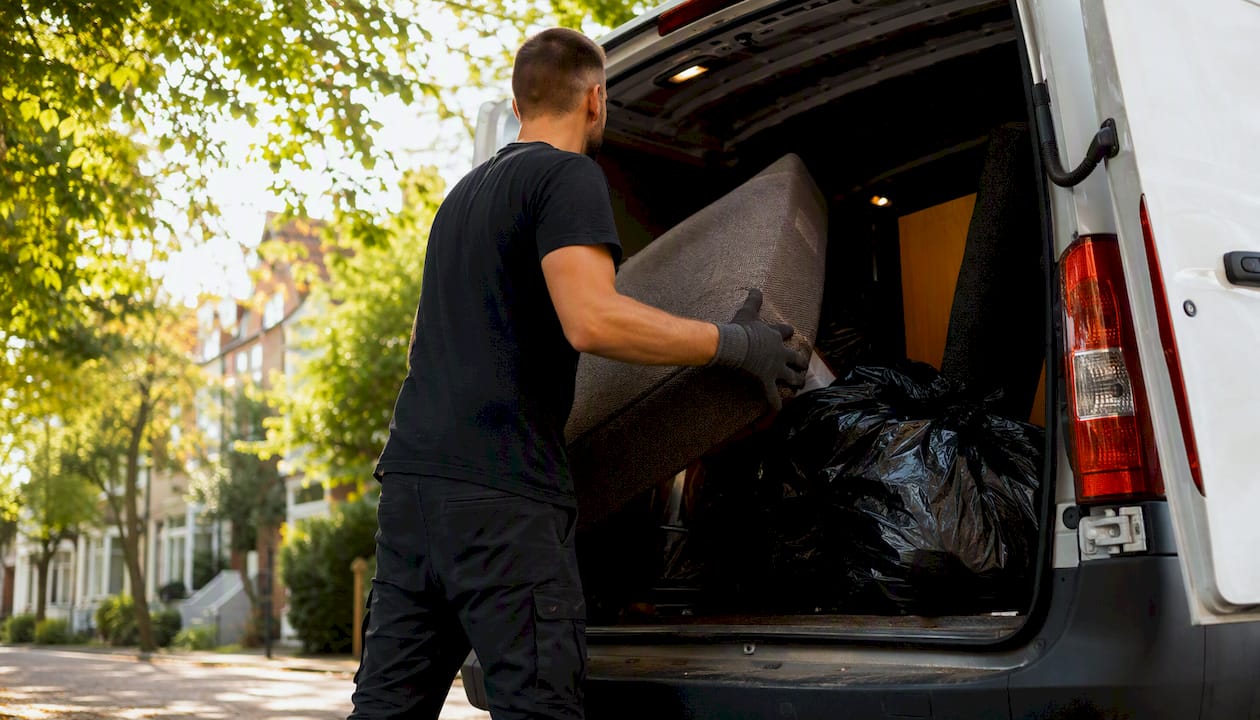
Skip hire suits large-volume clearouts where you want to fill at your own pace over several days. You pay a daily or weekly rental plus a weight charge. The downside: you need a driveway or a council permit for a skip on the road, and lead times of 24–48 hours are common.

Full house clearance is a managed service where a specialist team clears an entire property, often sorting for reuse or recycling as they go. Slower to book, but appropriate for a whole-house move with a lot of furniture.
Council bulky-waste collection is the cheapest option for a handful of large items, but most councils require 5–10 working days' notice and limit the number of items per booking. Not suitable for urgent clearouts.
Charity and donation pickup costs nothing and diverts good-condition furniture from landfill. British Heart Foundation Furniture & Electrical and similar organisations collect free of charge, though they only accept items in sellable condition and lead times vary.
Pro Tip: Combine options for a big move: book a marketplace carrier for bulky, heavy, or mixed rubbish on moving day, and arrange a charity pickup for good-condition sofas or wardrobes a few days before. You save money and divert more from landfill.
What does moving house rubbish removal actually cost in the UK?
Pricing varies significantly by region, volume, and service type, so treat the figures below as illustrative ranges rather than fixed quotes.
Most man-and-van and marketplace carriers price by load. A typical structure is a call-out fee (often £50–£80) plus a per-load charge. A quarter-van load might run £80–£120 all-in; a full van load typically costs £200–£350 or more in London and the South East, and somewhat less in the Midlands and North. Some carriers price per item for single pieces of furniture, usually £20–£60 per item depending on size and weight.
Skip hire adds a different cost shape: a small 2-yard skip for a few bags might cost £80–£130 per week in many areas, while a 6-yard skip (enough for a typical bedroom clearout) often runs £180–£280. Permit costs for a skip on a public road add a modest fee depending on the local authority.
Full house clearance is priced by property size and content volume. A one-bedroom flat might cost several hundred pounds; a three-bedroom house can be substantially more expensive, especially if sorting and donation are involved.
Several factors push the price up:
- Stairs and difficult access — crews charge more for upper floors or narrow corridors, since carrying time increases.
- Same-day or emergency booking — expect a premium of 20–40% over a standard booked slot.
- Hazardous or regulated items — fridges, freezers, and tyres require specialist disposal and are usually charged separately.
- Distance to disposal site — carriers further from a licensed tip or recycling centre may charge a mileage supplement.
- Weight overages on skip hire — exceeding the included weight allowance triggers a per-tonne surcharge.
Practical note: Load optimisation cuts cost more than most movers realise. Placing heavy items at the base of a load and staging everything near the access point before the crew arrives reduces carrying time, which directly reduces labour charges on time-based jobs. Guidance from container-rental practice (adapted from US market context) consistently shows that pre-staging near the exit point is the single biggest time-saver on collection day.
What will a crew take, and what gets left behind?
Most licensed carriers will collect the bulk of what a house move generates without any issue. Common accepted items include:
- Sofas, armchairs, and upholstered furniture
- Beds, mattresses, and bed frames
- Wardrobes, chests of drawers, and flat-pack furniture
- White goods (washing machines, dishwashers, tumble dryers)
- Boxed household items, crockery, and general clutter
- Small electrical appliances (kettles, toasters, microwaves)
- Garden furniture and tools
- Bagged general waste and cardboard
Regulated and hazardous items are a different matter. Carriers cannot legally mix these with general waste, and many will refuse them outright:
- Fridges and freezers — contain refrigerants that require specialist extraction; disposal must go through an approved WEEE (Waste Electrical and Electronic Equipment) route.
- Asbestos — any suspected asbestos-containing material (old floor tiles, pipe lagging, artex ceilings) must be handled by a licensed asbestos contractor.
- Paint, solvents, and oils — classified as hazardous waste; most household recycling centres accept small quantities.
- Gas bottles and cylinders — return to the supplier or contact a specialist.
- Tyres — most carriers exclude them; local tyre fitters or council sites often accept them.
- Clinical or medical waste — requires a specialist clinical waste contractor.
- Certain batteries — lithium-ion batteries from power tools or e-bikes need separate collection; most supermarkets and DIY stores accept standard AA/AAA batteries.
Pro Tip: Sort regulated items into a clearly labelled box or area before the crew arrives. Tell them upfront what is there. A good carrier will advise on the right disposal route; one who offers to "just take it anyway" is a red flag.
What happens when you book: timeline and collection day
The booking-to-collection timeline depends almost entirely on which service you choose and how much notice you give.
With a marketplace like Binshare, the process is fast by design. Post a job with photos and a description, and bids from verified local carriers typically arrive within minutes. Accept a bid, confirm the carrier's registration number, and same-day collection is often possible if you book before mid-morning. Next-day slots are almost always available. Traditional man-and-van firms work similarly: call before noon and same-day is usually achievable, though peak periods around month-end (when most tenancy agreements turn over) can stretch lead times.
Skip hire requires more planning. Most suppliers need 24–48 hours to deliver, and if you need a road permit, the council may take 3–5 working days to issue one. Full house clearance companies typically book 2–5 days ahead.
On collection day, the crew needs a few things from you:
- Clear access to the items, ideally staged near the front door or at ground level.
- Parking close to the property. If the street is permit-only, arrange a temporary suspension or warn the crew in advance.
- Someone present (or an authorised representative) to confirm the load and sign any paperwork.
- The carrier's registration number confirmed before they start loading.
After collection, you should receive a Waste Transfer Note or digital duty-of-care receipt. This is your legal proof that the waste was handed to a registered carrier. Keep it.
The UK legal checks you must make before booking
The household duty of care under the Environmental Protection Act 1990 places a legal obligation on anyone who produces waste to make sure it is disposed of properly. That obligation does not end when the van drives away. If your contractor fly-tips your rubbish, you can face a fine or prosecution, even if you had no idea it was happening.
Two checks protect you completely:
- Environment Agency waste carrier registration — every contractor who collects waste for payment must be registered. Ask for the registration number before you book, then verify it on the public register. The register is free, public, and takes under a minute to search. Note that multiple registrations appear on the same register, so always cross-check the specific number you have been given against the operator name on your booking.
- Waste Transfer Note or digital duty-of-care receipt — this document records what was collected, by whom, and where it is going. Request it after collection and keep it for at least two years.
Beyond these two essentials, ask for:
- Public liability insurance (protects you if the crew damages your property)
- Confirmation of where the waste will be taken (a named licensed facility)
- A recycling or diversion percentage if environmental credentials matter to you
Customer reviews on platforms such as Trustpilot are worth checking for patterns: repeated complaints about late arrivals, undocumented disposals, or surprise charges are consistent warning signs. Reviews are useful context, but they are not a substitute for checking carrier registration.
The single most reliable check is the Environment Agency public register. A registration number that does not appear there, or that belongs to a different company, is a hard stop.
How to choose the right provider for moving day
Run through this checklist before you confirm any booking.
| Question to ask | What a good answer looks like |
|---|---|
| Do you have a waste carrier registration number? | Provides the number immediately, without hesitation |
| Can I verify that number on the EA register? | Yes — and a trustworthy carrier will encourage you to |
| Will you provide a Waste Transfer Note or digital receipt? | Yes, issued after collection as standard |
| What is your call-out fee and what does it include? | Clear breakdown: call-out, load size, labour |
| Can you do same-day collection? | Confirmed availability or honest lead time |
| Where does the waste go? | Named licensed facility or recycling centre |
Red flags to walk away from:
- Refusal or evasion when asked for a carrier registration number
- Cash-only, no paperwork, no receipt
- Pressure to "just leave it on the pavement" or dump locally without documentation
- A price so low it cannot plausibly cover licensed disposal and labour
Decision framework: If you need same-day clearance, use a verified marketplace or a licensed man-and-van firm you can verify quickly. If you have 48 hours or more and a large volume, skip hire or a house clearance specialist may be more cost-effective. For a handful of good-condition items, arrange a charity pickup first and use a carrier only for what remains.
How Binshare works for moving-house rubbish removal
Binshare is a UK marketplace that connects householders directly with verified, licensed waste carriers. The process is built for speed and legal protection, which makes it a practical fit for moving-day clearouts.
Here is how a typical booking works:
- Snap a photo of the items you need removed and note any access details (stairs, parking, floor level).
- Post the job on the Binshare platform with your location and preferred collection window.
- Receive bids from verified local carriers, often within minutes.
- Check the carrier's registration — Binshare verifies carriers against Environment Agency records, and you can cross-check the number on the public register yourself.
- Accept the best bid and confirm the collection slot.
- Pay securely after collection through the in-app payment system.
- Receive a digital duty-of-care receipt that serves as your Waste Transfer Note, stored in the app for your records.
The platform also lets users list spare bin or skip space for community use, which means some jobs can be fulfilled using existing disposal capacity rather than a dedicated vehicle trip. That reduces cost and cuts unnecessary vehicle movements.
For movers, the practical benefits are:
- Rapid price discovery without ringing multiple firms
- Carrier verification built into the booking flow
- Legal protection through digital receipts
- Same-day collection available in most UK areas
- No upfront payment before the job is done
Pro Tip: When posting your job, include photos from multiple angles and note any awkward access (narrow hallway, no lift, street parking only). Carriers who bid with full information are less likely to revise the price on the day.
The moving-day mistakes most householders make
The most common error is not checking carrier registration at all. Most people assume that if a firm has a website and a van, it is legal. That assumption is wrong often enough to matter. Unregistered operators are not rare, and the householder who hired them is the one who ends up liable when the waste turns up in a lay-by.
The second mistake is underestimating labour and time. A two-bedroom flat sounds manageable until you factor in three flights of stairs, a sofa that does not fit the lift, and a street with no parking. Movers who have not staged items in advance regularly find that a job quoted for two hours runs to four.
The third is forgetting regulated items until the crew is at the door. A fridge or a tin of old paint that nobody thought about becomes a last-minute problem that either delays the job or gets left behind.
The pragmatic best choice for most movers is a verified marketplace booking: fast, documented, and legally protected. For large volumes with more lead time, combine that with skip hire or a charity pickup for good-condition items. The combination covers most scenarios without overpaying.
Binshare: verified, fast rubbish removal for your move
Booking moving-day rubbish removal through a traditional firm means ringing around, waiting for callbacks, and hoping the carrier is actually registered. Binshare cuts that process to minutes: post your job, get competitive bids from verified carriers, and pay only after the waste is gone.
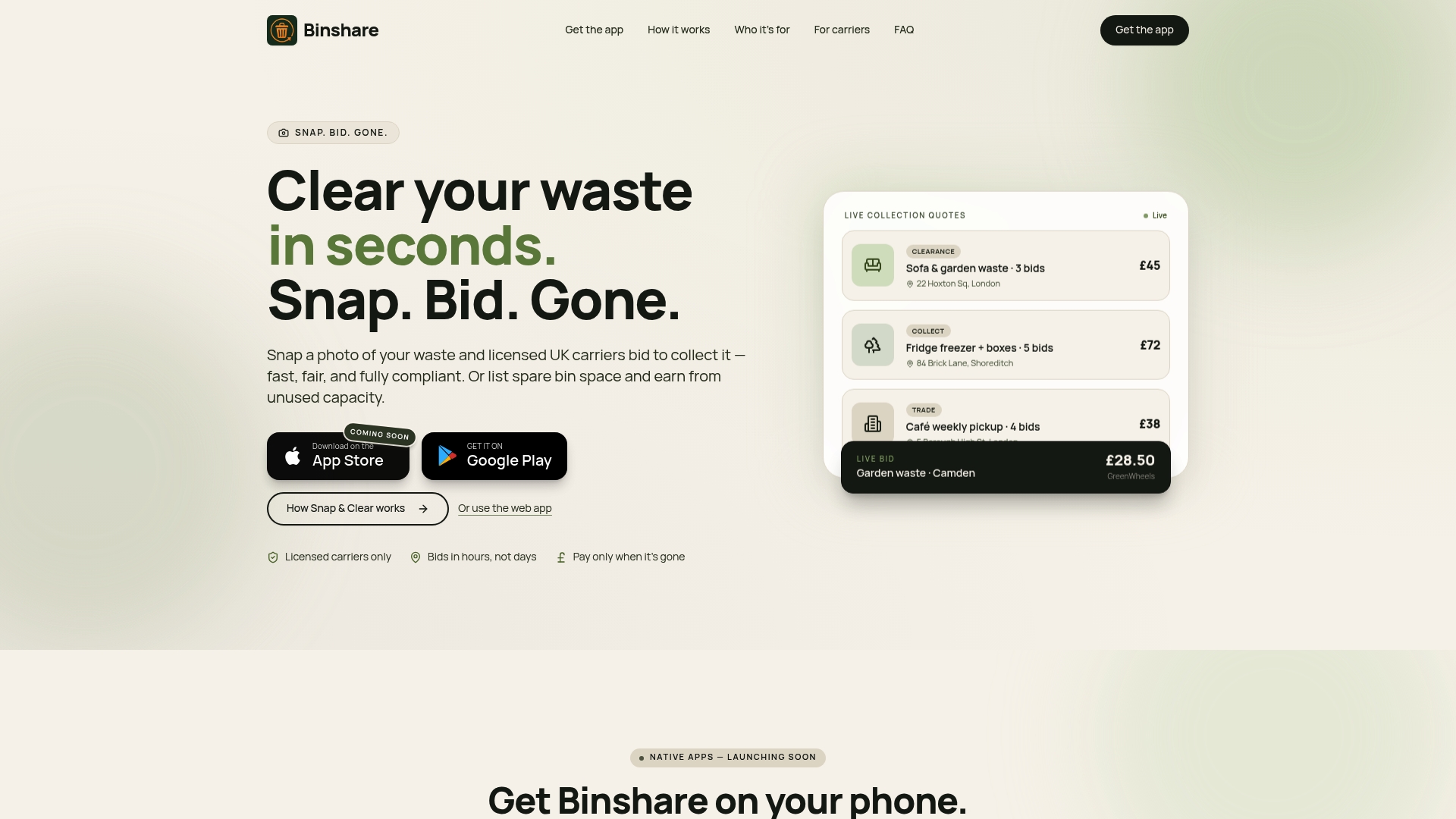
For movers who need speed, legal protection, and a clear paper trail, Binshare delivers all three in one booking:
- Verified Environment Agency carrier registration on every job
- Digital duty-of-care receipt issued after collection
- Competitive bids, often within minutes of posting
- Same-day collection available across the UK
- Secure in-app payment, no upfront cost
Post your first job at Binshare and have verified bids in your inbox before the removal van arrives.
Sources
- Environment Agency: waste carriers register entry CBDU129843
Keep your Waste Transfer Note alongside your moving paperwork. If a dispute arises about where your waste ended up, that document is your legal protection.