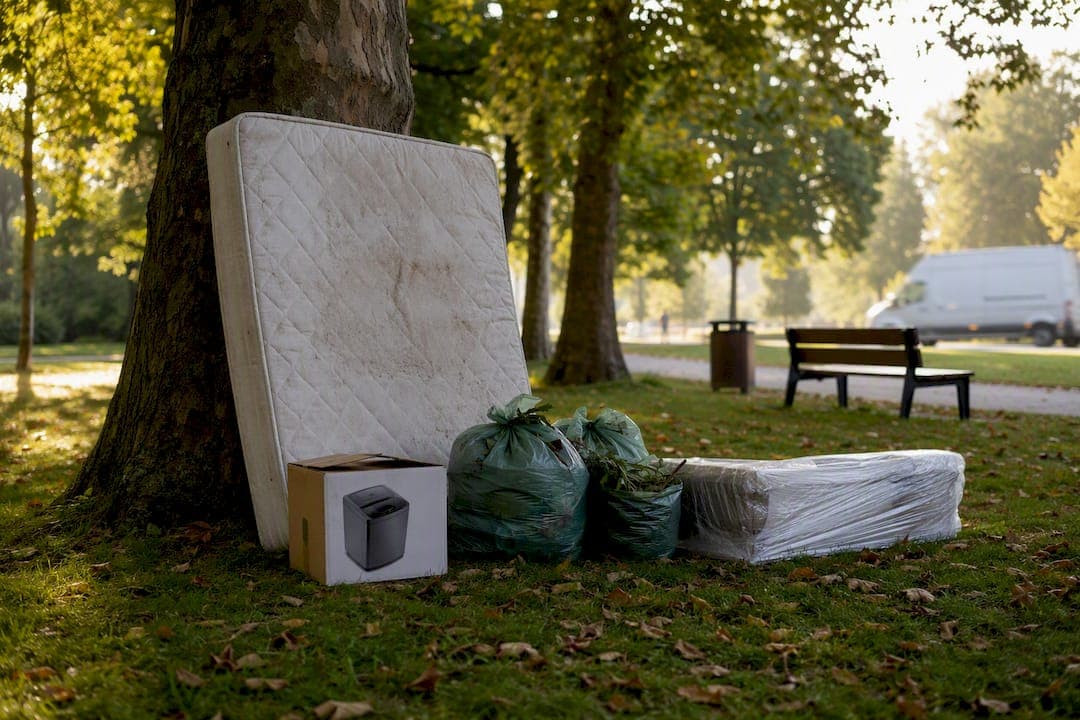
If you have no car, the fastest safe route is one of four things: book a council bulky collection, use a verified private carrier, arrange a charity uplift, or get a neighbour (or Binshare) to run smaller loads to the reuse and recycling centre. Every one of those routes keeps you on the right side of your duty of care, which is the legal bit most people skip past until it costs them a fine.
Two things to do right now, before you read any further:
- Check your council's website for its bulky waste collection booking page and note the reference number once you book.
- Search the Environment Agency public register for any private carrier before you let them near your rubbish.
Everything below expands on those four routes, including how a marketplace such as Binshare fits into the picture as a verified, quick alternative when council waits feel too long.
Key Takeaways
Verifying a private carrier against the Environment Agency register and keeping a duty-of-care receipt is the single non-negotiable step in any no-car rubbish disposal method.
| Point | Details |
|---|---|
| Check the register first | Search any private carrier on the Environment Agency public register before letting them collect. |
| Match the route to the item | Use council bulky collection for furniture, charities for reusable goods, and private carriers for speed. |
| Recycling centres vary by site | Confirm pedestrian access and vehicle rules on your local council's RRC page before travelling on foot. |
| Always get a receipt | A digital or paper duty-of-care receipt is your only real protection against a fly-tipping fine. |
| Binshare fills the speed gap | Binshare pairs you with Environment Agency verified carriers and issues a digital receipt automatically. |
Table of Contents
- No car rubbish disposal: your practical shortlist
- Can you use a recycling centre without a car?
- How do council bulky collections and charity uplifts work?
- How do you check a private waste carrier is legal?
- What does no-car rubbish removal typically cost?
- Getting rubbish to a drop-off point without a vehicle
- What happens if you give rubbish to the wrong person?
- How Binshare solves the no-car disposal problem
- One-minute checklist before you hand over your rubbish
- Get your rubbish collected today, no car needed
- Sources
No car rubbish disposal: your practical shortlist
Without a car, the question isn't really "how do I get rid of this?" It's "which route matches this item, this deadline, and my budget?" Here's the shortlist, roughly in the order most households reach for them.
Council kerbside bins first. Anything that fits your normal wheelie bin or recycling box goes out on collection day, no transport needed at all. This is the default for everyday rubbish and it costs nothing extra, so rule it out before considering anything else.
Council bulky waste collection for furniture, appliances and large items. Most councils run a paid or part-subsidised uplift service where a crew comes to your door on an agreed date. You book online or by phone, get a reference number, and leave the item out (or answer the door) on collection day. This is usually the best option for a sofa, mattress, or fridge when you're not in a rush.
Reuse and recycling centres (RRCs) for things you can carry yourself. Bags of garden waste, small electricals, old paint tins, that sort of thing. The catch: many centres are built around vehicle drop-off and restrict or ban pedestrian access outright, which we'll unpack in the next section.
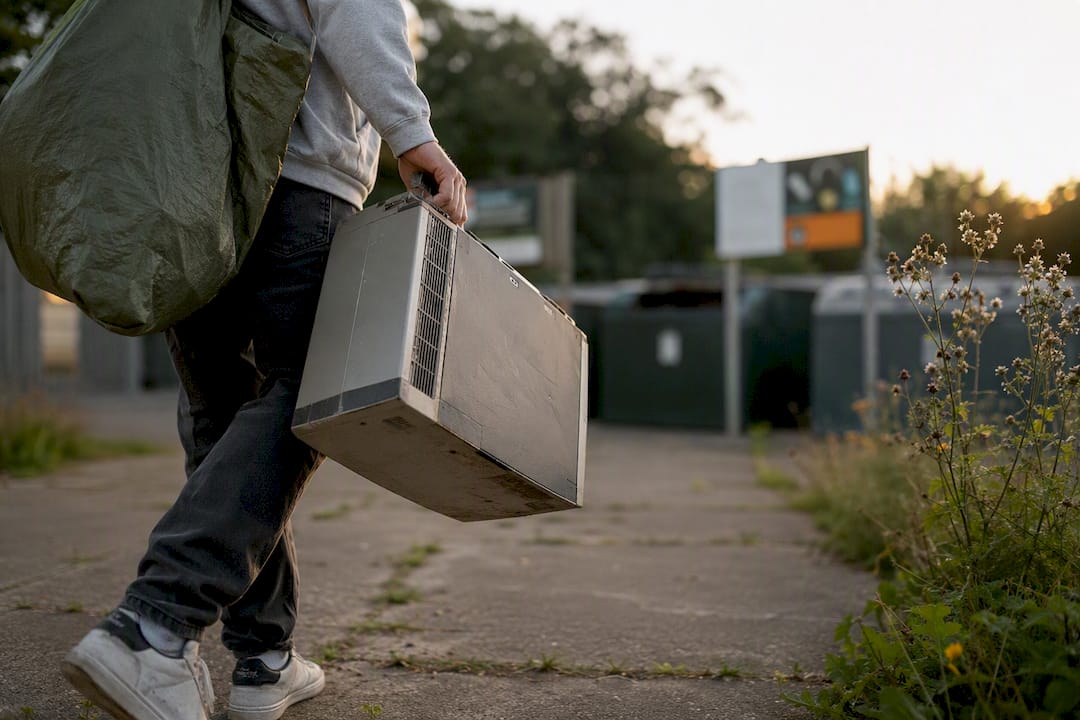
Charity collections and doorstep uplift for anything reusable. Furniture, working electricals, and household goods in decent condition often qualify for a free charity pickup, provided the items pass a basic condition check.
Licensed private carriers and marketplaces like Binshare for speed. If you need something gone this week and none of the free routes fit your timeline, a verified carrier booked through a platform can often collect within 24 to 48 hours.
| Route | Best for | Typical wait |
|---|---|---|
| Kerbside bin | Everyday household rubbish | Next scheduled collection |
| Council bulky collection | Furniture, white goods | Days to a few weeks |
| Reuse and recycling centre | Small loads you can carry | Same day, if pedestrian access allowed |
| Charity uplift | Reusable furniture and goods | Days to two weeks |
| Private carrier / marketplace | Anything, when speed matters | Often same day to 48 hours |
Pro Tip: Photograph every item before you dispose of it, whichever route you choose. It speeds up charity condition checks, backs up your duty-of-care paperwork, and gives you proof of what left your property and when.
Choosing between these isn't complicated once you know the trade-offs. Council routes are cheapest but slowest. Charities are free but selective about condition. Private carriers cost more but move fast and take almost anything, hazardous items aside. The item type and your deadline decide which one wins.
Can you use a recycling centre without a car?
Sometimes, but don't assume it. Recycling centres were largely designed around vehicle drop-off, and a fair number now state plainly that pedestrians aren't admitted at all. Some centres explicitly say there's no pedestrian access and direct anyone without transport to their council's alternative services instead.
Others are more flexible but still charge differently depending on what you bring and how. Abbey Road Household Reuse and Recycling Centre lists charges from £16 for loads up to 100kg brought by car, with separate rules for vans and trailers, illustrating how vehicle category drives both access and cost at a typical site.
Booking systems vary by area too. North London Waste Authority explains how van and trailer visits are still booked differently from standard car visits in some boroughs, while Redbridge's centre sets out its own opening hours and what residents can bring. None of this is standardised nationally, so the site rules for your nearest centre are the only ones that matter.
If your local RRC won't admit pedestrians, you have three realistic workarounds:
- Ask a neighbour with a car to make the trip, splitting fuel or offering to help with their own next load.
- Look for a community drop-off point or reuse hub reachable on foot or by bus, some councils run smaller satellite sites specifically for this.
- Book a verified carrier through a marketplace, who collects from your door and disposes of it correctly on your behalf.
Pro Tip: If you're relying on someone else's car, pack items to travel safely, not just to fit. Wrap sharp edges, empty liquids from containers, and keep the load low and secured. A centre attendant can refuse an unsafe or improperly loaded vehicle, which wastes everyone's trip.
Keep whatever booking reference or receipt the centre gives you. If a query ever comes up about where an item went, that reference is your proof.
How do council bulky collections and charity uplifts work?
Council bulky collections are usually booked online through your local authority's waste pages, and you'll need a reference number before crews arrive, so keep it somewhere you can find it. Brent's bulky waste service is a fair example of the process: choose your items, pick a date, pay if a charge applies, and leave the items accessible on collection day. Councils generally accept furniture, mattresses, and white goods, though most exclude certain hazardous or oversized items that need separate arrangements.
Charities work differently. Kent County Council's guidance points residents towards reuse and donation routes first, and for good reason: a sofa in good nick is worth more to someone else than it is sitting in landfill. The trade-off is that charities typically run a condition check before booking a pickup, often asking for photographs and measurements upfront.
A few things speed the process along:
- Photograph items clearly, including any damage, before you contact a charity.
- Give accurate dimensions so the collection team knows what vehicle to send.
- Book council collections as early as your council allows, slots fill up faster around bank holidays.
Reuse beats disposal whenever an item is genuinely still usable, both financially and environmentally. Save the council or private-carrier route for things that are actually at the end of their life.
How do you check a private waste carrier is legal?
This is the part most guides skim past, and it's the one that can actually cost you money. GOV.UK guidance is direct on this: you remain legally responsible for your waste until it's disposed of properly, and if you hand it to someone who isn't a registered waste carrier and they fly-tip it, you can be fined even though you didn't dump it yourself.
The fix takes about two minutes. Run through this before anyone loads a single bag into a van:
- Search the carrier's name or registration number on the Environment Agency public register.
- Ask for a duty-of-care receipt, digital or paper, at the point of collection.
- Note the vehicle registration plate and the driver's stated business name.
- Confirm where the waste is actually going, a legitimate carrier will tell you without hesitation.
A carrier who can't produce a registration number or refuses to give any form of receipt isn't someone you should be handing your rubbish to, regardless of how cheap the quote sounds.
Practitioners in the sector generally agree that a written or digital receipt recording vehicle details and carrier information is the single strongest protection a householder has if a dispute ever arises. Without it, you have no evidence you did your due diligence.
Never accept a suspiciously cheap "man with a van" offer with no paperwork. If the price seems too good given the size of the job, that's often because the waste is heading straight for an illegal tip, not a licensed facility, and you'll be the one on the hook. For a fuller rundown of red flags to watch for with unlicensed operators, this guide on spotting unlicensed movers covers the same warning signs that apply to waste collection.
What does no-car rubbish removal typically cost?
Costs vary more by route than by item, so it's worth knowing the shape of each before you commit.
Council bulky collections tend to run from free to a modest fee per load, depending on the authority and how many items you're clearing, with lead times ranging from a few days to a couple of weeks depending on demand. Charity uplifts are usually free but move slower, since they're fitted around donation demand and condition checks rather than a fixed schedule.
Private carriers and marketplaces work on a quote-per-job basis rather than a flat rate, since price depends on volume, item type, and access. The trade-off for that variable pricing is speed: many verified carriers on platforms like Binshare can often collect within a short time window, typically within a couple of days, which no council service can usually match.
- Council: cheapest, slowest, book online with a reference number.
- Charity: free, but subject to a condition check and photo request.
- Private carrier: quoted per job, fastest turnaround, verify registration first.
Budget a modest fee where speed matters. A few extra pounds spent on a verified carrier is cheaper, in every sense, than the fine and stress of an item you handed off going missing or turning up fly-tipped.
Getting rubbish to a drop-off point without a vehicle
Assuming you have a car is the default most guidance is written around, so here's what actually works when you don't.
Ask a neighbour or friend first. It costs nothing beyond fuel or a favour returned, and it's often the fastest option for a single bulky item heading to an RRC.
Book a minicab with a boot, or a proper man-and-van service, for anything too large for a standard taxi. Most private hire firms will take a small load if you ask when booking, though they can refuse anything that risks damaging the vehicle.
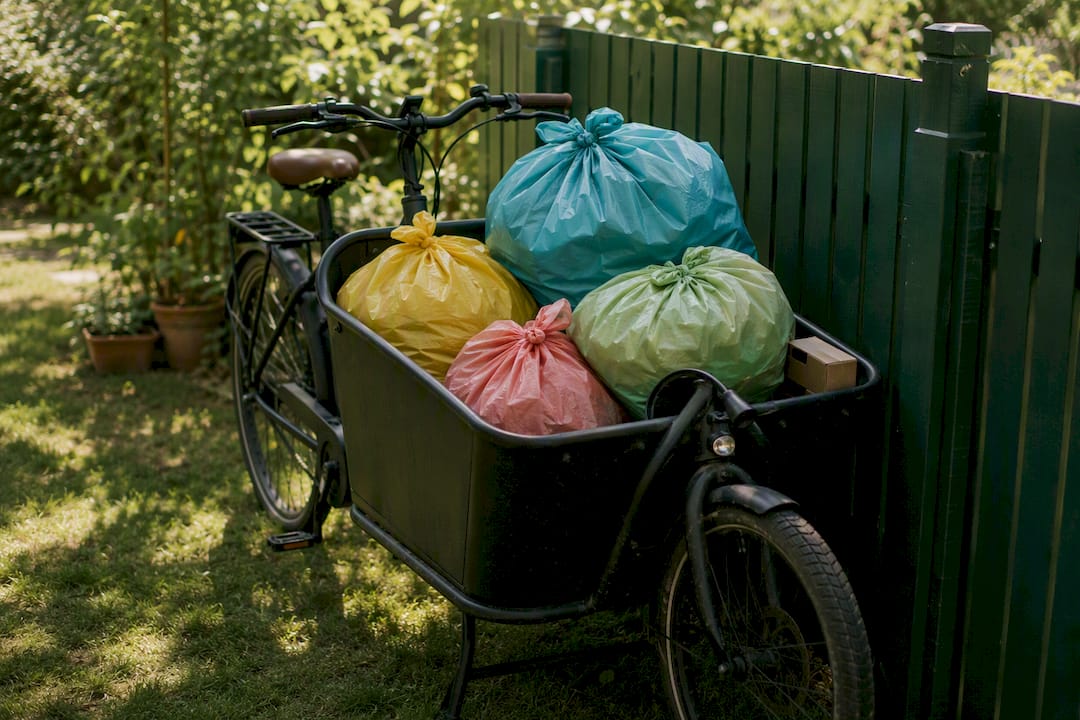
A cargo bike or bike trailer handles small to medium loads surprisingly well, bags of clothes, small furniture, boxed electricals, and it's genuinely the greenest option on this list if you have one available.
Public transport carries real restrictions worth knowing. Most bus and train operators allow small bagged items but prohibit anything that blocks aisles, has sharp edges exposed, or could leak. Check your local operator's conditions of carriage before attempting to bring bulky rubbish aboard.
Courier-on-demand apps can shift single boxed items between two points, useful for smaller electricals heading to a specialist recycler rather than a general RRC.
- Neighbour or friend: free, best for one-off single items.
- Minicab or man-and-van: modest cost, handles medium loads.
- Cargo bike: free if owned, ideal for bagged or boxed items.
- Public transport: check carrier conditions before you travel.
- Courier apps: good for single boxed items, not bulky furniture.
Whatever method you choose, load safely: keep weight low, secure loose items, and never overload a boot or trailer to the point it affects visibility or handling. When the load is heavier or more awkward than any of these methods comfortably manage, that's your signal to book a paid carrier instead of improvising.
What happens if you give rubbish to the wrong person?
The householder stays legally responsible for their waste right up until it reaches lawful disposal, not just until it leaves the doorstep. GOV.UK's guidance is unambiguous that fly-tipped waste traced back to your address can result in a fine for you, even if someone else physically dumped it.
If you spot fly-tipping, whether it's your own waste or someone else's, report it to your council's waste enforcement team and, for larger or repeated incidents, the Environment Agency. Keep whatever evidence you have: receipts, photographs of the items before collection, the carrier's vehicle registration, and any messages exchanged when arranging the job.
Never hand over rubbish to someone offering to "sort it" for cash with no paperwork and no registration check. If it goes wrong, you carry the legal consequence, not them.
That single rule, verify before you hand anything over, prevents almost every horror story in this space.
How Binshare solves the no-car disposal problem
Binshare exists precisely for the gap between "I need this gone" and "I have no way to get it there." You photograph the item, describe roughly what it is, and verified carriers on the platform bid for the job, so you're choosing between real quotes rather than guessing at a price over the phone.
Every carrier on Binshare is checked against Environment Agency registration before they can bid, which removes the single biggest legal risk described earlier in this article. Once collection happens, you get a digital duty-of-care receipt automatically, no chasing a driver for paperwork, no wondering later whether you're covered.
What this looks like in practice:
- Snap a photo of the item and post it, no vehicle or measuring tape required.
- Compare bids from carriers already verified against the Environment Agency register.
- Pay securely through the app once collection is confirmed.
- Receive a digital duty-of-care receipt as your proof of lawful disposal.
This sits alongside council and charity routes rather than replacing them, it's the option for when speed matters more than cost, or when your local RRC simply won't let you in on foot. Binshare also lets households with spare bin or skip capacity list it for others nearby, turning space that would otherwise go unused into a paid booking for someone stuck exactly where you might be right now.
One-minute checklist before you hand over your rubbish
Run through this before any collection, whether it's a council crew, a charity van, or a private carrier at your door.
- List what you're getting rid of and roughly how much it weighs or how many items there are.
- Search the Environment Agency public register for the carrier's name or registration number.
- Get a duty-of-care receipt, digital or paper, before the vehicle leaves.
- Write down or screenshot your booking reference, whichever route you used.
- Photograph the items before handover, in case a dispute ever arises.
If anyone can't produce registration details or refuses a receipt, refuse the handover and report it to your council instead. No exceptions, however convenient the offer sounds.
Hazardous items, paint, chemicals, gas canisters, certain electricals, need specialist disposal through your council's designated collection point, not a general carrier or bin.
Pro Tip: Keep a running note on your phone of every disposal reference and receipt for the year. If your council or the Environment Agency ever asks how an item was disposed of, you'll have the answer in seconds rather than digging through old emails.
Why verification matters more than convenience
The temptation without a car is to grab whichever option feels easiest, the first van that pulls up, the neighbour who "knows a bloke." I'd push back on that instinct. Convenience without verification is exactly how fly-tipping fines land on people who did nothing wrong except skip a two-minute registration check.
Marketplaces and shared bin space aren't a replacement for your council's bulky collection or a good local charity, they're a third option for when those two don't fit your timeline. The one rule that never bends, whichever route you pick, is duty of care. Verify the carrier, get the receipt, keep the reference. Everything else is preference.
Get your rubbish collected today, no car needed
Council bulky collections and charity uplifts are genuinely good options, but they take time you might not have, and neither helps if your item needs to be gone this afternoon. Binshare is built for exactly that gap: a verified carrier at your door, often within a short time frame, with none of the "is this person actually licensed?" guesswork.
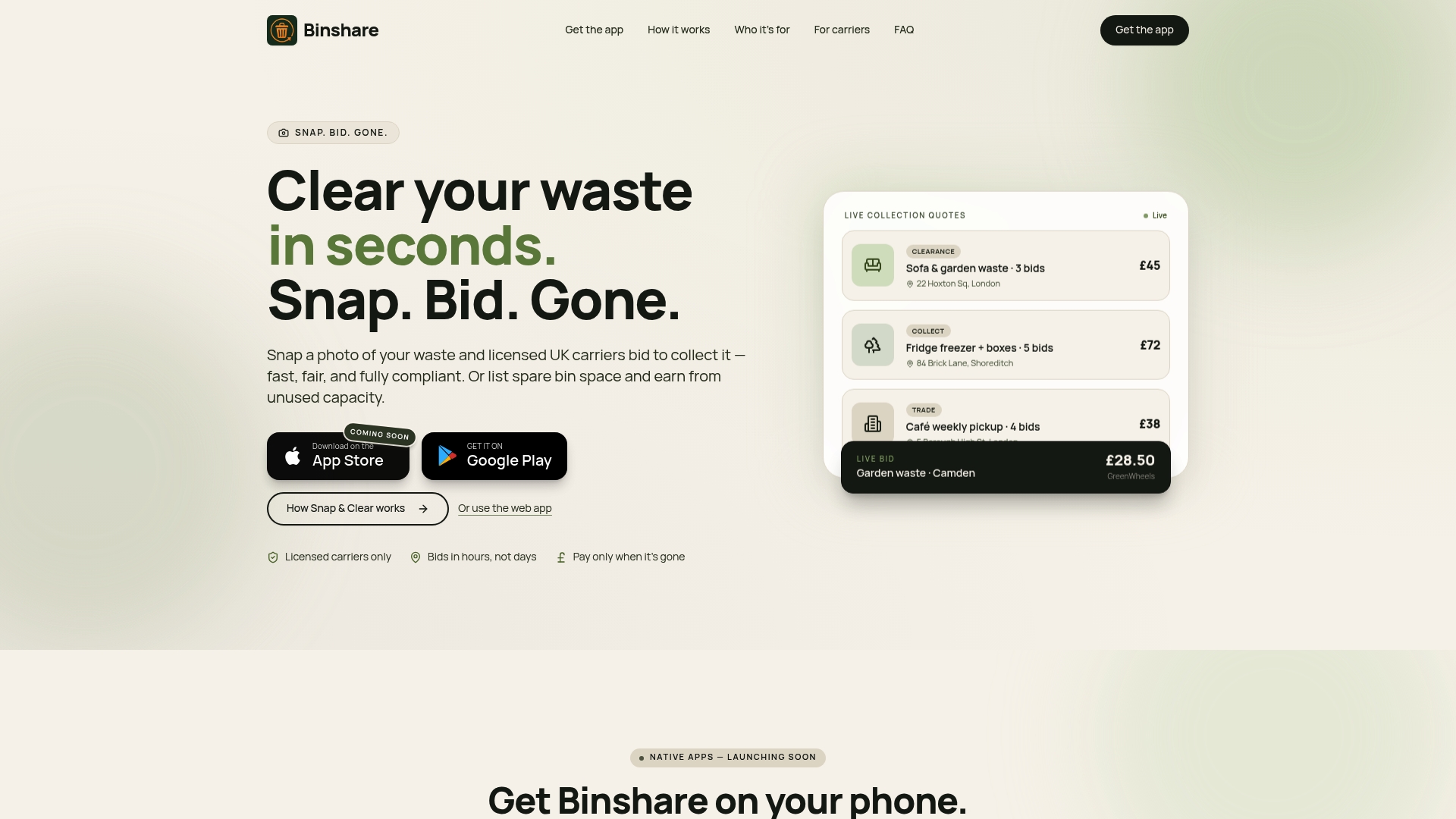
Every carrier on the platform is checked against the Environment Agency register before they're allowed to bid on your job, and you get a digital duty-of-care receipt the moment collection is confirmed, so there's no paperwork chase afterwards. Trust signals worth knowing:
- Verified carriers, checked against the Environment Agency register before bidding.
- Digital duty-of-care receipts issued automatically after collection.
- In-app messaging so you can confirm details directly with your carrier.
Snap a photo of what needs to go, post it, and compare bids from verified carriers in minutes. Get a quote through Binshare and have it collected without ever needing to borrow a car.
Sources
- Dispose of household waste
- Abbey Road Household Reuse and Recycling Centre
- Visit a reuse and recycling centre
- Booking a visit to a Reuse and Recycling Centre