
Identify your paint type first, then follow this hierarchy: donate or reuse good-quality paint, harden small amounts of water-based paint for household waste, and take solvent-based or large volumes to a household waste recycling centre (HWRC) or licensed carrier. Never pour any paint down a drain.
Your quickest next step by scenario:
- Small water-based tin (emulsion or acrylic, less than a quarter full): Harden it with cat litter or a commercial hardener, let it dry completely, then place it in your household bin — check local rules first, as some councils vary.
- Large volume of water-based or any solvent-based paint: Take it to your nearest HWRC or donate it via Community RePaint. Never attempt to harden solvent-based paint at home.
- Trade or industrial quantities: You need a licensed waste carrier and a duty-of-care transfer note. A marketplace like Binshare can connect you with verified carriers quickly.
The PaintCare trial running in the West Midlands accepts leftover decorative paints free of charge at participating sites, showing that take-back schemes are gaining real traction in the UK. The reuse-first approach is the most environmentally sound option regardless of volume.
Key takeaways
The safest, most legally sound approach to paint disposal in the UK is to identify the paint type first, exhaust reuse and donation options, and only move to disposal when reuse is genuinely not possible.
| Point | Details |
|---|---|
| Reuse before disposal | Donate usable paint via Community RePaint or Freegle before considering any disposal route. |
| Harden small water-based tins | Use cat litter or a commercial hardener; only bin when fully solid and less than a quarter tin, per local rules. |
| Hazardous paint needs specialist disposal | Solvent-based paints, thinners, and aerosols must go to an HWRC hazardous day or a licensed carrier — never the bin or drain. |
| Use GOV.UK to find local services | The GOV.UK postcode tool locates hazardous waste services in England and Wales; use SEPA or DAERA for Scotland and Northern Ireland. |
| Binshare for licensed collections | Binshare connects you with verified carriers, competitive bids, and digital duty-of-care receipts for larger or hazardous loads. |
This article is general information, not a substitute for advice from a qualified lawyer. Consult a qualified legal professional about your own circumstances before acting on anything here.
Table of Contents
- How to reuse, donate, and reduce paint waste at home
- Local drop-off options: HWRCs, Community RePaint, and the PaintCare trial
- How to harden paint safely before disposal
- Solvent-based paints and other hazardous coatings: what you must do differently
- How to find and book the right local service
- When you need a licensed waste carrier
- Legal obligations and safety warnings
- A practical view on choosing the right route
- Binshare takes the friction out of compliant paint collection
- Sources
How to reuse, donate, and reduce paint waste at home
The best outcome for leftover paint is never disposal at all. A half-used tin of emulsion in good condition can last years if stored correctly, and donating it costs nothing.
Storing paint for future touch-ups
Before writing off a tin, check whether it is still usable. Press the lid firmly shut, store the tin upright in a cool, frost-free place (a garage or under-stairs cupboard works well), and label it with the room and colour. When you come back to it, stir thoroughly and test on a piece of card. If it smells off, has separated beyond recovery, or has gone lumpy, it has reached the end of its useful life.
Donating through Community RePaint, Freegle, and Freecycle
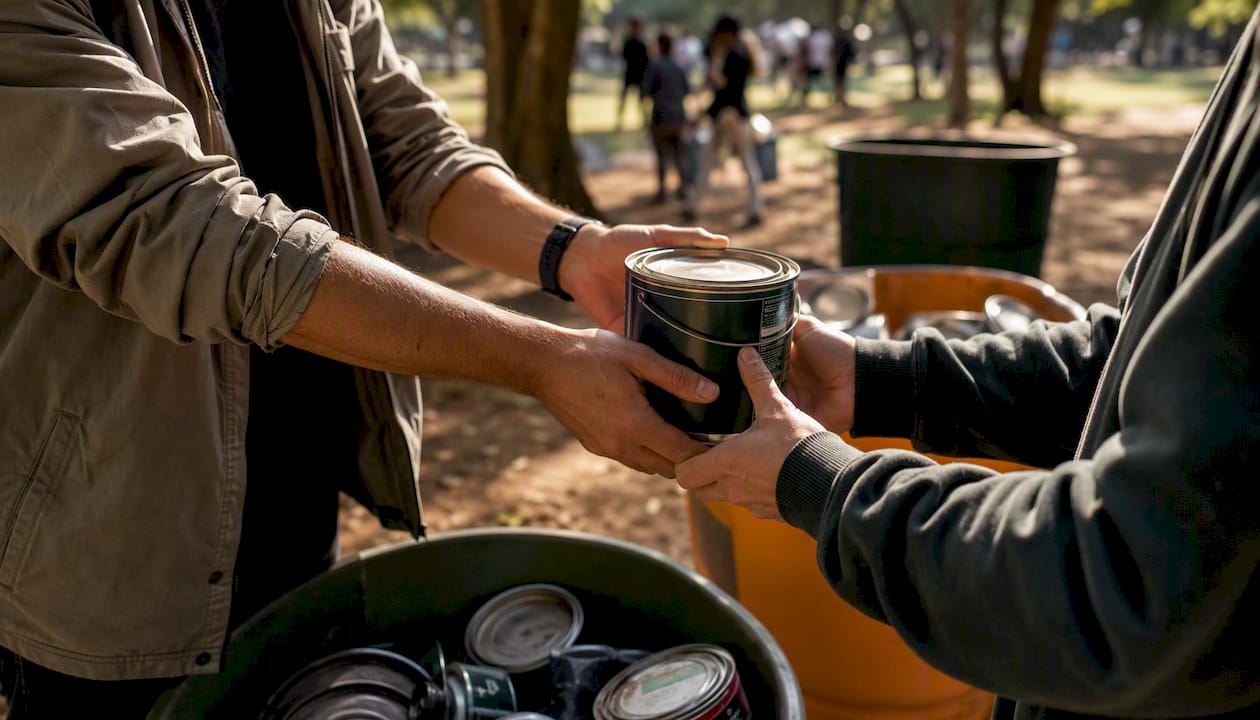
Community RePaint runs a national network of drop-off points where good-quality leftover paint is redistributed to community projects, charities, and households in need. It is the most structured route for paint donation in the UK. Prepare your donation by keeping the original tin, securing the lid, and not mixing colours or types. Freegle and Freecycle are useful for passing on paint directly to neighbours or local groups when Community RePaint drop-off points are not nearby.
When small amounts can go in the household bin
RecycleNow advises that councils generally cannot accept liquid paint at recycling centres, but once paint is completely dry and solid, small amounts may go in your household rubbish. The key word is completely — a skin on top is not enough. Check your local council's guidance, as rules vary.
- Keep leftover paint to a minimum by measuring your surfaces before buying. Use the manufacturer's coverage guide (typically printed on the tin) to calculate litres needed, then add no more than 10% for wastage.
- Buy in smaller tins when finishing a room rather than opening a new large tin.
- Mix partial tins of the same colour and type for undercoats or priming rather than buying new.
Pro Tip: *Use a paint calculator on the manufacturer's website before every project. Measure wall height times width, subtract doors and windows, and divide by the coverage figure on the tin.
Local drop-off options: HWRCs, Community RePaint, and the PaintCare trial
When home storage and donation are not options, your local HWRC or a reuse scheme is the next step.
What HWRCs typically accept
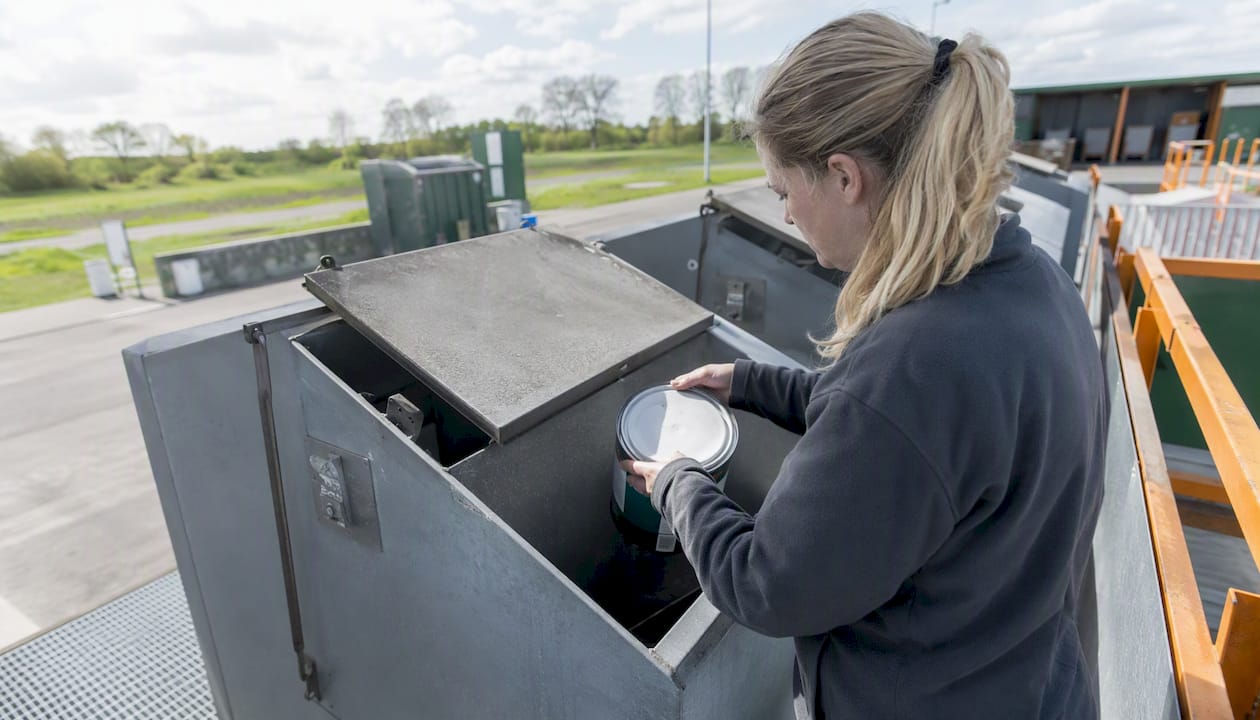
Most household waste recycling centres will take empty paint tins (metal or plastic), dried and solidified paint, and sometimes small volumes of liquid paint on specific hazardous waste days. What they will not accept is liquid paint in standard drop-off conditions. Council HWRC policies differ significantly: some require a pre-booked slot, others ask for proof of residency or a resident permit, and a handful charge for certain waste streams. Checking your council's HWRC page before travelling is the fastest way to avoid a wasted trip.
Community RePaint drop-off points
Community RePaint accepts paint that is in its original tin, has the lid intact, and has not been mixed with other types or colours. The network covers much of England, Scotland, and Wales, though coverage varies by region. Paint donated through the scheme goes directly to people and projects that need it, making this the highest-value environmental outcome for any usable tin.
The PaintCare West Midlands trial
PaintCare, run by the British Coatings Federation, is operating a take-back trial in the West Midlands that accepts leftover decorative paints free of charge at participating sites. The trial has per-visit and weekly limits and excludes industrial coatings and highly hazardous products. It is worth checking the PaintCare site for current participating locations and any updates to accepted volumes. The trial's data collection aims to build the case for a national take-back scheme, so participation genuinely matters.
- Empty metal paint tins with clean lids can often be recycled as scrap metal at recycling centres — worth asking at the gate.
- Liquid paint is refused at most HWRCs outside of hazardous waste days; do not assume it will be accepted on a standard visit.
- Some councils run annual household hazardous waste days that accept small volumes of liquid paint that would otherwise be turned away year-round. These events are seasonal and have specific item lists, so check Norfolk County Council's guidance as a practical example of how these days work.
How to harden paint safely before disposal
Hardening water-based paint at home is straightforward and keeps it out of the liquid waste stream. Follow these steps carefully.
- Check the paint type. This method applies only to water-based paints: emulsion, acrylic, and latex. Never attempt to harden solvent-based paint (gloss, satinwood, oil-based undercoat) at home.
- Choose your hardening agent. Cat litter is the most effective and widely available option. Sawdust, soil, or a commercial paint hardener (available from DIY retailers) all work. Add roughly equal volumes of absorbent to paint and stir thoroughly.
- Leave the lid off. For small amounts in a tin, stir in your absorbent, then leave the tin in a well-ventilated area with the lid off. Thin layers dry faster — spread the mixture across the tin's base rather than leaving it deep.
- Check for complete drying. Press a stick or screwdriver into the centre of the tin. If it meets resistance all the way through with no wet paint underneath, it is ready. A dried skin on top with liquid below is not sufficient.
- Dispose of the solid tin. Once completely solid, small amounts of dried emulsion or acrylic paint may go in your household rubbish — Suffolk Recycling's guidance specifies less than a quarter tin, fully dried, and double-bagged. Larger dried volumes can go to your HWRC.
- Recycle the empty tin. Clean metal tins with no residue can be recycled as scrap metal at many recycling centres. Check with your local site.
Drying time varies: a shallow layer of emulsion mixed with cat litter may solidify in 24–48 hours in warm conditions; a deeper tin can take several days. Do not rush it.
Never attempt to harden solvent-based paint, thinners, or any product labelled flammable at home. These require specialist disposal and pose a serious fire and pollution risk if handled incorrectly. When in doubt, take it to an HWRC hazardous drop-off or book a licensed carrier.
When you have a large volume of good-quality paint, hardening it is a waste of a usable resource. Donate it instead.
Solvent-based paints and other hazardous coatings: what you must do differently
Solvent-based products are a different category entirely, and the rules are stricter for good reason.
What counts as hazardous
- Solvent-based gloss, satinwood, and oil-based undercoats
- White spirit, paint thinners, and brush cleaners
- Two-pack coatings and epoxy paints
- Wood preservatives and varnishes containing solvents
- Aerosol paints (even partially used cans)
- Residues and rags soaked in any of the above
Why they cannot go in the bin or down the drain
These products are flammable, toxic, and capable of contaminating watercourses. Pouring them down a sink or drain is an offence under the Water Industry Act 1991 and can cause serious harm to sewage treatment systems and wildlife. Even small amounts of solvent poured to a drain can travel far through the water system before breaking down.
Pouring solvent-based paint or thinners down a drain is illegal and can result in prosecution, a significant fine, and liability for clean-up costs. Keep containers sealed, upright, and labelled until they reach a licensed disposal point.
What to do with hazardous paint
- Take it to your HWRC on a designated hazardous waste day. Check your council's schedule in advance, as these days are often seasonal.
- Use the GOV.UK hazardous waste finder to locate your nearest licensed hazardous waste service.
- Book a licensed waste carrier for larger volumes or if you cannot transport the material safely yourself.
- Keep all containers sealed, upright, and in their original packaging where possible. Transport them in the boot of your vehicle in a sturdy box, never loose.
Do not mix solvent-based and water-based paints in the same container. Mixed batches are frequently rejected at drop-off points and classed as general waste, which defeats the purpose entirely.
How to find and book the right local service
Knowing the right route is half the job. Here is how to locate the correct service quickly.
- Use the GOV.UK hazardous waste finder. For England and Wales, enter your postcode at GOV.UK's hazardous waste disposal page to find council-run collections and licensed services near you.
- Scotland: Contact SEPA (Scottish Environment Protection Agency) or check your local council's waste pages for HWRC locations and hazardous waste collection dates.
- Northern Ireland: DAERA (Department of Agriculture, Environment and Rural Affairs) provides guidance on household hazardous waste disposal and links to local council services.
- Check your council's HWRC page before travelling. Look for: booking requirements, resident permit rules, opening hours, accepted waste types, and whether liquid paint is accepted only on special days.
- Confirm what to bring. Most HWRCs require proof of residency (a utility bill or council tax letter). Some have per-visit quantity limits for hazardous materials.
What to bring and how to prepare
- Tins with lids secured and labels intact (original labels help staff identify contents)
- Proof of residency if required by your council
- Containers upright and packed in a box or crate to prevent spillage in transit
- Separate water-based and solvent-based products — do not combine them in one box
Staff at HWRCs will direct you to the correct skip or container. For dried paint and empty tins, the general recycling area is usually appropriate. Liquid paint and hazardous products go to a separate, staffed area.
When you need a licensed waste carrier
Most households can manage paint disposal through the routes above. But certain situations call for a licensed carrier.
When to hire one
- You have trade or commercial quantities of paint (even if generated at home during a large renovation)
- The load includes mixed hazardous wastes: solvents, thinners, and paint together
- You need a duty-of-care transfer note for your records or for a landlord, letting agent, or contractor
- You cannot transport the material safely yourself
- Your HWRC has refused the load or does not accept your waste type
What to check before booking
- The carrier's Environment Agency waste carrier licence number (ask for it directly and verify it on the Environment Agency's public register)
- Whether the carrier is insured for hazardous waste transport
- What disposal route they use and whether they can provide documentation
- A written duty-of-care transfer note — keep it for at least two years
Cost and timing
Costs for a licensed carrier collection vary by volume, location, and waste type. A single-visit collection for household quantities is generally more expensive than an HWRC drop-off, which is often free for residents. Some councils charge for hazardous collections even at HWRCs, so confirm costs before booking. Lead times for a licensed carrier are typically shorter than waiting for a council hazardous waste day, which may only run once or twice a year. For professional house clearances involving hazardous materials, understanding the benefits of professional house clearance can help set realistic expectations about what a compliant service covers.
Pro Tip: Binshare lets you upload a photo of your waste, receive competitive bids from verified, Environment Agency-registered carriers, and pay securely after collection. You get a digital duty-of-care receipt automatically, which removes the paperwork burden entirely.
Legal obligations and safety warnings
A short list of the rules that matter most.
- Never pour paint down a drain or into a watercourse. This applies to all paint types, including water-based. It is an offence under the Water Industry Act 1991.
- Never put liquid paint in your household bin. Norfolk County Council's guidance is clear on this, and it reflects national rules: liquid paint must be hardened or taken to a licensed disposal point.
- Keep duty-of-care records. When you transfer waste to a carrier, you must receive a written transfer note and keep it for at least two years. This applies to householders as well as businesses for larger or hazardous loads.
- Check your council's rules before every disposal. Local authority policies on what HWRCs accept, booking requirements, and hazardous waste days change regularly.
- Do not mix paint types. Mixing water-based and solvent-based paints in one container renders the batch unsuitable for reuse or recycling and complicates disposal.
Pouring paint down a drain or placing liquid paint in household waste can result in prosecution and fines under UK environmental law. This article provides practical guidance only — for complex regulatory questions, contact your local authority or a qualified environmental consultant.
A practical view on choosing the right route
The reuse-first hierarchy is not just an environmental ideal — it is the most practical starting point for most households. A half-used tin of emulsion has real value to someone, whether that is a neighbour, a community project, or a local charity. Before reaching for the cat litter, spend two minutes checking Community RePaint's drop-off map.
For small dried amounts, the household bin is a legitimate option where local rules allow, and there is no need to make it more complicated than it is. The real complexity sits at the hazardous end: solvent-based paints, thinners, and aerosols need proper handling, and the consequences of getting it wrong — a blocked drain, a contaminated watercourse, or a fine — are not worth the shortcut.
Where volume or hazardous content makes a licensed carrier the right call, the paperwork matters as much as the collection itself. A duty-of-care transfer note is your proof that the waste was handled legally. Binshare makes that process straightforward: verified carriers, competitive bids, and digital documentation without the phone calls.
Binshare takes the friction out of compliant paint collection
When you have more paint than an HWRC will take, a mix of hazardous and non-hazardous products, or simply no time to wait for a council hazardous waste day, Binshare offers a faster, fully documented alternative.

Upload a photo of your paint and waste, receive competitive bids from Environment Agency-verified carriers, and pay securely once the collection is complete. Every job comes with a digital duty-of-care receipt, so your legal obligations are covered without any paperwork on your part. Carriers on the platform are checked for licence compliance before they bid, which removes the risk of hiring an unregistered operator. For anyone managing a larger renovation clear-out or a mix of paint types, this is a more reliable route than trying to coordinate multiple council services. Check the Binshare hazardous items list before booking, then get your first bids today.
Sources
- Find a local hazardous waste disposal service
- Paint | RecycleNow
- Give your leftover paint new life
- PaintCare - British Coatings Federation Ltd
- Recycling and disposing of paint - Norfolk County Council