
Skip hire in the UK typically costs between £90 and £650 per hire, depending on skip size, your location, and whether you need a council permit. A fair working figure for most domestic jobs is around £220 per week for a standard builders skip. Permits add an additional fee when the skip sits on a public road, varying by council.
The three things that move the price most are skip size, where you live, and what you're putting in it. Get those three right before you call a supplier and you'll avoid the most common budgeting mistakes.
Quick reference by job size:
- Mini skip (2–3 yd): roughly £80–£200 per hire; suits a bathroom clearance or garden tidy
- Midi skip (4–5 yd): roughly £130–£280; covers a kitchen fit-out or small renovation
- Builders skip (6–8 yd): roughly £180–£480; the standard choice for a full room strip or extension
- Maxi/RoRo (10 yd+): roughly £400–£650; large site clearances and commercial work
Pro Tip: Always ask for a quote that itemises delivery, collection, disposal, and any permit fee separately. A single "all-in" price is fine, but you need to know what's included before you can compare two quotes fairly.
Key takeaways
UK skip hire costs range from around £80 for a mini skip to over £650 for a large RoRo, with a typical builders skip coming in near £220–£320 per week before permit fees.
| Point | Details |
|---|---|
| Price range by size | Mini skips run £80–£200; builders skips £180–£480; maxi/RoRo £400–£650 per hire. |
| Permit costs | Council permits typically cost £15–£80 and are required whenever a skip sits on public land. |
| Main surcharges | Overweight loads, lockable skips (£50–£150 extra), plasterboard separation, and extension weeks are the most common hidden costs. |
| London premium | London and South East prices sit at the top of national ranges; northern regions are typically cheaper. |
| Binshare alternative | For small or same-day jobs, Binshare connects you with verified carriers for on-demand collection with digital duty-of-care receipts. |
Table of Contents
- How much does skip hire cost by size?
- What factors push your skip hire price up or down?
- Council permits: what you need to know and what they cost
- How hire duration affects what you pay
- How to choose the right skip size and cut your costs
- Alternatives to traditional skip hire worth considering
- The case for rethinking the default skip
- A faster alternative to skip hire: try Binshare
- Sources
How much does skip hire cost by size?
Size is the single biggest lever on price, so it's worth understanding what each skip actually holds before you commit. The table below covers the main skip sizes UK suppliers offer, with typical 2026 price ranges, capacity, and common uses.
| Skip size (yd) | Typical price range (per hire) | Capacity (bin bags / m³) | Typical uses | Permit required? | Common extras |
|---|---|---|---|---|---|
| 2–3 yd (mini) | £80–£200 | 20 bags / 2 m³ | Garden waste, small clearances | Rarely | Overfill surcharge |
| 4–5 yd (midi) | £130–£280 | 40–50 bags / 4 m³ | Kitchen/bathroom strip-outs, flat clearances | Sometimes | Permit if on road |
| 6–8 yd (builders) | £180–£480 | 55–80 bags / 6 m³ | Full room renovations, extensions, mixed waste | Often | Overweight, permit |
| 10 yd (maxi) | £400–£650 | 100–120 bags / 8–10 m³ | Large site clearances, roofing, commercial | Usually | Permit, weight limits |
| RoRo (20–40 yd) | £400–£650+ | 200+ bags / 15–30 m³ | Commercial demolition, bulk light waste | Yes | Specialist haulage |
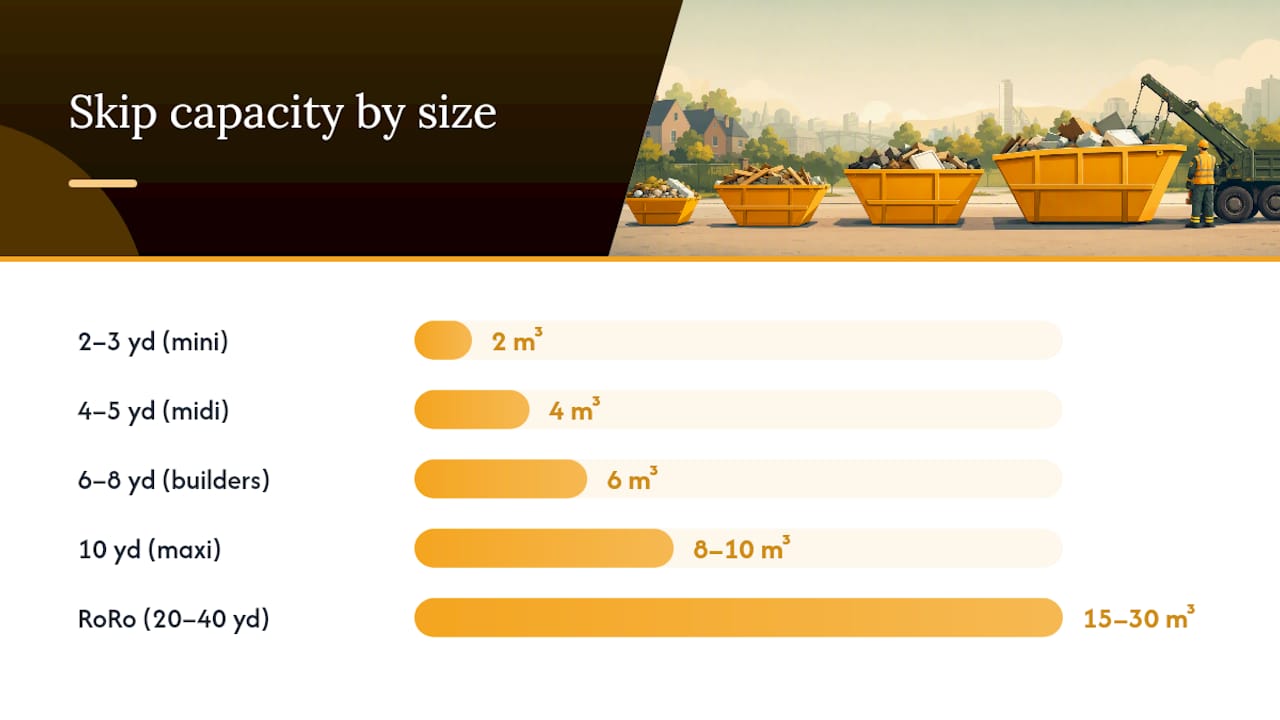
Ranges sourced from Checkatrade, Best Builders, and HowMuchShouldItCost 2026 price guides.
Choosing the right size
The bin-bag equivalents are a practical starting point. If you're on the boundary between two sizes, go up: a half-empty larger skip costs the same as a full smaller one, but an overfilled skip triggers a surcharge.
- 2–3 yd mini: one-room clearances, hedge trimmings, a single bathroom
- 4–5 yd midi: kitchen or bathroom renovation, flat clearance, moderate garden landscaping
- 6–8 yd builders: full house clearance, loft conversion waste, mixed renovation debris
- 10 yd+ maxi: roofing projects, large extensions, commercial strip-outs
The Homebuilding cost guide puts a 4 yd skip at roughly £150–£250 ex VAT and an 8 yd at £250–£350 ex VAT, which gives a useful cross-check against local quotes.
Regional price callout: London and the South East
London and South East suppliers consistently sit at the top of national price ranges, driven by higher landfill gate fees, congestion, and haulage costs. A builders skip that costs £280 in Manchester or Leeds can easily reach £420–£480 in Greater London. Northern regions and parts of Wales and Scotland tend to come in at the lower end of published ranges. Always get at least two local quotes rather than relying on a national average.

What factors push your skip hire price up or down?
Price variance between quotes for the same skip size can be surprisingly wide. Understanding what drives it helps you compare like for like and spot where a cheap quote might hide a nasty surcharge.
Primary drivers:
- Location and region: London and the South East carry a premium due to landfill costs and haulage distances. The further a skip yard is from your address, the higher the delivery charge.
- Waste type: Heavy materials such as soil, concrete, and rubble weigh far more per cubic metre than general household waste. Most skips have a weight limit (often 1–2 tonnes for a builders skip), and exceeding it triggers an overweight surcharge.
- Access: A skip placed on a narrow street, behind a locked gate, or requiring a long wait for the driver adds to the cost. Some firms charge a waiting-time fee if the lorry can't drop or collect quickly.
- Hire duration: Standard hire is one to two weeks. Extensions cost extra, typically charged per additional week.
Secondary factors that catch people out:
- Lockable skips add roughly £50–£150 to the hire price, but are worth it on a public road or shared site.
- Same-day or weekend delivery usually carries a premium of £20–£50 above standard rates.
- Plasterboard must be kept separate from general waste under UK landfill regulations. Mixing it in with other materials can result in a specialist disposal surcharge.
- Electrical items (fridges, freezers, monitors) and tyres are prohibited in most skips and attract a separate disposal fee if included.
- Wait-and-load services, where the driver stays while you fill the skip, are charged by the hour rather than by the week.
Pro Tip: Separate plasterboard, fridges, and electricals before the skip arrives. Keeping them out of the general load avoids specialist disposal surcharges that can add £50–£100 to the final bill. Some firms will take them separately for a fixed fee, which is almost always cheaper than a mixed-load surcharge.
According to industry guidance, on-road permits typically add £30–£80 to the hire cost, and overweight surcharges vary by firm but are commonly charged per tonne above the agreed limit. Haulage distance and logistics, including the type of vehicle needed for your site, also feed directly into the base price — a point worth bearing in mind if your access is restricted. For context on how haulage distance affects costs, the further the load travels to a licensed disposal facility, the more that feeds into the quote.
Council permits: what you need to know and what they cost
A skip permit is legally required whenever a skip is placed on public land, including the road outside your house, a pavement, or any public car park. If the skip fits entirely on your private driveway, you don't need one. Gov explains the licensing process and confirms that permits are issued by local councils, not central government.
Most skip hire firms will apply for the permit on your behalf and add the council fee to your invoice. That's convenient, but the fee varies by council and it's worth confirming the exact amount before you sign off on a quote.
Typical permit costs and duration:
Permit fees across UK councils commonly fall in the range of £15–£60, though some London boroughs charge more. Permits are usually issued for one to two weeks. If your hire runs longer, you'll need an extension, which means a fresh application and another fee.
What can go wrong without a permit:
- The council can issue a fixed penalty notice to the skip hire firm, which is often passed on to the customer.
- The skip may be removed at your expense.
- Your firm's operating licence can be affected, which is why reputable suppliers won't place a skip on a road without one.
Questions to ask your supplier about permits and extras:
- Is the permit fee included in your quote, or charged separately?
- Which council will you apply to, and how long does approval take?
- What is the weight limit for this skip, and what happens if I exceed it?
- Which materials are excluded from this hire?
- Is there a charge for extending the hire period?
- Do you charge for same-day or weekend collection?
Many firms include permit handling in their quote as a standard service, but permit fees vary by council and should be confirmed before booking, not assumed.
How hire duration affects what you pay
Most skip hire is priced as a flat fee covering delivery, a standard hire period (typically one to two weeks), collection, and disposal. That all-in model is straightforward, but the details matter when your job runs long or finishes early.
Standard hire models:
- Flat weekly hire: one price covers delivery, the hire period, collection, and disposal. Extensions are charged per additional week, commonly £30–£80 depending on skip size and location.
- Wait-and-load: the driver stays on site while you fill the skip, then takes it away immediately. Charged by the hour, typically £60–£120 per hour. No permit needed if the skip never sits on the road.
- Same-day collection: useful for small jobs or when you have no driveway. Usually carries a premium over standard hire.
When extensions add up:
A builders skip at £320 for two weeks becomes £370–£400 if you need a third week. On a longer renovation, those extension fees can quietly add £100–£200 to the total. If you know the job will take a month, ask whether the firm offers a fixed extended-hire rate upfront, which is often cheaper than rolling weekly extensions.
When to consider pay-per-collection instead:
- Small, irregular volumes of waste where a skip would sit half-empty for weeks
- Urban jobs where a permit would be needed every week
- Businesses with ongoing but unpredictable waste volumes
For those situations, on-demand collection or a marketplace service can work out cheaper once permit and extension fees are factored in.
How to choose the right skip size and cut your costs
Getting the size wrong is the most common and most avoidable skip hire mistake. Too small and you're paying for a second hire; too large and you're paying for capacity you don't use.
- Estimate your waste volume in bin bags. Walk through the project and count roughly how many standard (90-litre) black bags the waste would fill. Add 20% for awkward shapes and underestimated volumes.
- Check what you can't put in the skip. Confirm with your supplier which materials are excluded. Plasterboard, fridges, tyres, paint, and asbestos all have restrictions. Knowing this upfront lets you arrange separate disposal before the skip arrives.
- Measure your access. A midi skip is roughly 3.5 metres long; a builders skip around 4 metres. Check that a lorry can reach the drop point and that the skip won't block a neighbour's driveway or a dropped kerb.
- Confirm permit requirements before booking. If the skip must go on the road, factor in the permit fee and the application timeline (some councils take 48–72 hours to approve).
- Ask about weight limits. If you're disposing of soil, concrete, or rubble, a smaller, heavier-rated skip may be better value than a large one that triggers an overweight surcharge.
Cost-saving tactics that actually work:
- Combine multiple small jobs into a single larger skip hire. One 8 yd skip is almost always cheaper than two 4 yd hires.
- Separate heavy materials (soil, hardcore) and take them to a local recycling centre or arrange a grab lorry, which is priced by weight and often cheaper for pure rubble.
- Reuse or donate items before they go in the skip. Furniture, appliances, and building materials in reasonable condition can be collected free by charities or listed on local exchange groups.
- For small bulky loads, a wait-and-load service avoids the permit cost entirely and can be cheaper than a week's hire.
A midi skip at roughly £225 is better value than two mini hires at £125–£160 each when the total waste volume sits at 40–50 bags. The second mini hire also means a second delivery charge, which erodes any apparent saving.
Pro Tip: Photograph your waste pile before calling for quotes. A photo lets the supplier give you a more accurate size recommendation and a firmer price, reducing the chance of a surprise surcharge when the skip is collected. Ask for a written quote that lists permit fees and disposal charges separately.
Alternatives to traditional skip hire worth considering
A skip is not always the most cost-effective or practical answer. For urban jobs, small clearances, or sites with no driveway, several alternatives can save money and hassle.
Common alternatives:
- Wait-and-load: a driver arrives, you load the vehicle together, and it leaves the same day. No permit, no week-long skip on the road, and no extension fees. Best for small to medium loads where you can work quickly.
- Man-and-van clearance: a team collects and loads for you. Priced by van load or by the hour. Convenient but more expensive per cubic metre than a skip for large volumes.
- Grab hire: a lorry with a hydraulic grab arm collects loose material (soil, rubble, hardcore) directly from your site. Efficient for heavy materials that would overload a standard skip.
- Roll-on roll-off (RoRo): large open containers for bulk light waste on commercial sites. Cost-effective at scale but overkill for domestic jobs.
- Bin and skip space sharing: platforms that connect you with nearby hosts who have spare bin or skip capacity, or with verified carriers who collect on demand.
| Option | Best for | Cost shape | Access needed | Typical job size |
|---|---|---|---|---|
| Standard skip hire | Renovations, multi-day fills | Flat weekly fee | Driveway or permit | Medium to large |
| Wait-and-load | Small loads, urban jobs | Per hour | Street access | Small |
| Grab hire | Heavy rubble, soil | Per tonne/load | Open ground | Medium to large |
| Man-and-van | Mixed bulky items | Per load/hour | Any | Small to medium |
| Marketplace collection | On-demand, flexible volumes | Per job | Any | Any |
For small, urban jobs with no driveway, wait-and-load or a marketplace collection can be cheaper than a skip once permit and obstruction fees are factored in. The weight and transport logistics behind heavy-material removal also make grab hire worth pricing separately for rubble-heavy jobs.
Binshare operates as a marketplace connecting you with verified, Environment Agency-registered carriers who bid competitively for your job. Snap a photo of your waste, receive bids, and pay after collection. You also get a digital duty-of-care receipt, which matters if you're a business with legal waste disposal obligations. For jobs where a skip feels like overkill, or where a permit would eat into the budget, it's a practical alternative worth pricing alongside a traditional hire.
The case for rethinking the default skip
The skip is the default answer to almost every clearance question in the UK, and most of the time it's a reasonable one. But the default is worth questioning more often than people do.
A standard builders skip on a London street costs £350–£480 for two weeks, plus a permit, plus the risk of an overweight surcharge if the rubble is heavier than expected. For a job that could be done in a day with the right carrier, that's a lot of money sitting on the road doing nothing for thirteen of those fourteen days.
The environmental case for rethinking the skip is also stronger than it looks. A skip that travels to a transfer station, gets sorted, and then travels again to a landfill or recycling facility generates more vehicle movements than a direct collection to the right facility. Binshare's model of matching waste to verified carriers who are already operating nearby reduces those redundant journeys. The duty-of-care receipt the platform issues also closes the loop on legal compliance, which matters for businesses and landlords who can't afford a waste transfer note gap.
That said, a skip is genuinely the right tool for a long renovation where waste accumulates over weeks, or for a large mixed load that needs to sit on site. The mistake is treating it as the only tool. For small loads, urban jobs, or anything that can be cleared in a single visit, pricing a marketplace collection alongside a skip quote takes five minutes and can save £100 or more.
A faster alternative to skip hire: try Binshare
Skip hire is the right call for many jobs, but not all of them. If your clearance is small, your access is tight, or a two-week permit feels disproportionate to a one-day job, Binshare offers a concrete alternative: photograph your waste, receive competitive bids from verified, Environment Agency-registered carriers, and pay only after collection.

Three things set it apart from a traditional hire. First, quotes arrive fast, without the back-and-forth of calling multiple skip firms. Second, every carrier on the platform is verified for legal compliance, and you receive a digital duty-of-care receipt automatically. Third, if you have spare bin or skip space, you can list it on Binshare and earn from capacity that would otherwise go unused. No permit paperwork, no extension fees, no overfill surcharges.
Visit Binshare to photograph your waste and get your first bids today.
Sources
- Gov
- Skip hire cost calculator 2026 | Costwise
- Skip Hire Prices: Cost Breakdown 2026 | Try Our Job Estimator Tool
- Skip Hire Cost UK 2026 | Prices & Quotes
- Skip Hire Cost UK: £80–£200 (2026) | Price Guide
- How much does a skip cost? | Homebuilding
Last reviewed: June 2026. Prices are indicative ranges based on published 2026 guides; always get a local quote for your specific job.