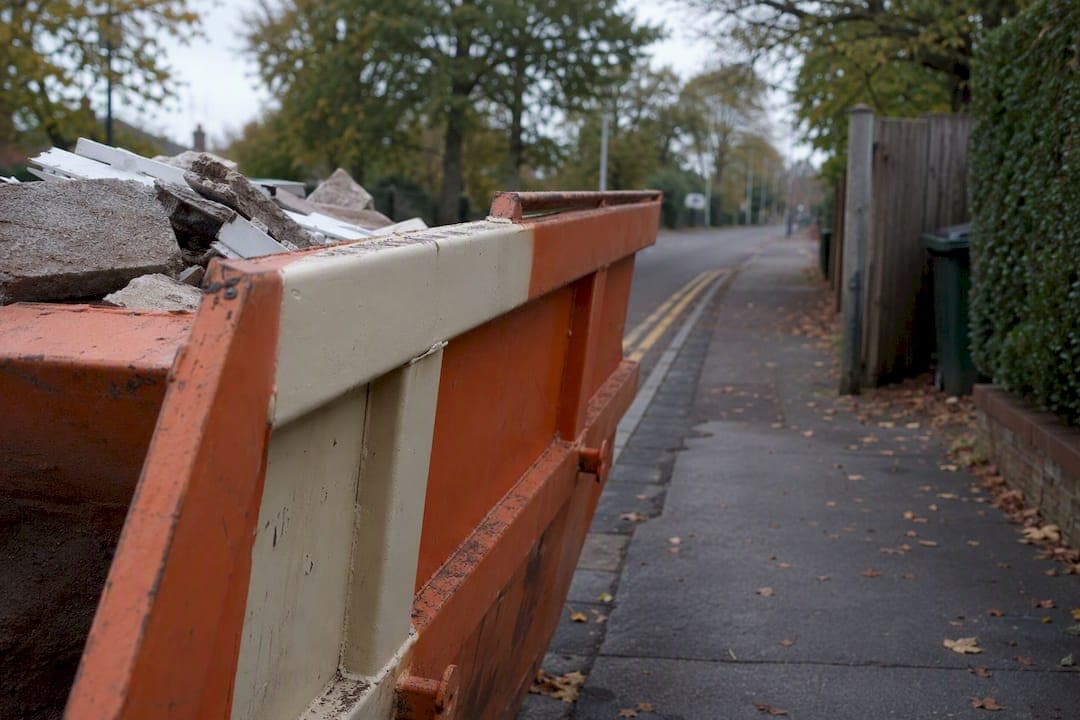
Yes, if any part of your skip touches a public road, pavement or verge, you need a permit. If it sits entirely on your own driveway or land, you don't. For the ones that do need one, budget roughly £45 to £100 for the base permit in most council areas, though it can run from £17 in Sheffield up to over £260 in pricier boroughs once suspensions get involved.
The legal basis is straightforward: the highway is the highway, whether it's a busy road or a grass verge outside your house, and placing a skip there without permission risks enforcement under the Highways Act 1980.
- Permit needed: any part of the skip on public highway
- No permit needed: skip fully on private land (driveway, garden, yard)
- Typical cost range: fees vary significantly depending on council and extras such as parking suspension charges
Pro Tip: Ask your skip hire company for an all-in quote before you book. Permit fees rarely tell the whole story once parking suspensions get added.
Key Takeaways
Skip permits are only required when part of the skip sits on public highway, and total cost usually depends far more on parking suspension charges than on the base permit fee.
| Point | Details |
|---|---|
| Legal test | A permit is required if any part of the skip touches public road, pavement or verge. |
| Base permit range | Expect £17 to £260, with most councils charging between £45 and £100. |
| Who applies | The skip operator usually applies and invoices you, but some councils require the customer to apply directly. |
| Watch the extras | Parking-bay suspension fees, charged daily per bay, often exceed the permit fee itself. |
| Smaller-job alternative | Binshare offers permit-free, on-demand collection through verified carriers for loads that don't need a full skip. |
Where to check local rules and apply
- Start with Gov for the legal basics
- Check your specific council's page, such as Manchester, Camden or Bristol
- Search your local authority by name if it isn't listed here
Table of Contents
- When do you actually need a skip permit?
- How much does a skip permit typically cost?
- Who applies for the skip permit, and how do you get one?
- Why parking suspensions often cost more than the permit itself
- What safety standards do councils expect on the highway?
- What happens if you skip the permit?
- How long does a permit last, and how fast can you get one?
- What should you confirm before booking a skip?
- A permit-free route worth considering for smaller jobs
- Sources
When do you actually need a skip permit?
The test councils apply is simple: does any part of the skip sit on public land? That includes the road itself, the pavement, and grass verges, even the bit of verge that looks like it belongs to your front garden. If the answer is yes, you need a permit before the skip arrives. A skip parked entirely within your own boundary, on a driveway or in a private yard, needs no permit at all.
A few situations catch people out:
- Pedestrianised streets and city centre zones often carry extra restrictions or outright bans on skip placement
- Verges that look private but are actually adopted highway (common on newer estates)
- Roads near schools, bus stops or junctions, where councils may refuse placement regardless of permit status
When you're not sure, ring the council directly rather than guessing. Skip hire firms deal with this daily and will usually flag the risk before you commit, but the legal responsibility for an unpermitted skip can still land on the person who ordered it.
How much does a skip permit typically cost?
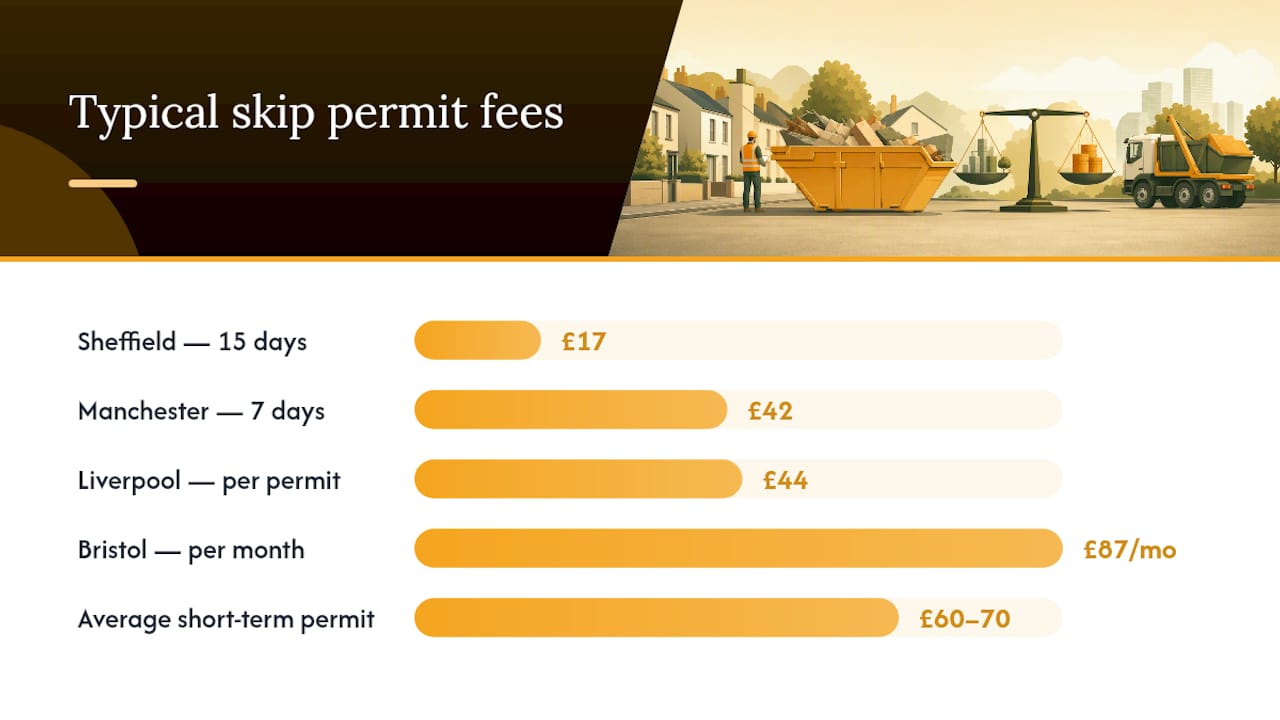
Fees vary far more than most people expect, because every council sets its own rate and its own charging period. National pricing guides put the typical range somewhere between £12.50 and £260, with an average closer to £60 to £70 for a standard short-term permit.
Council examples make the spread obvious:
- Manchester: around £42 per permit, valid for a maximum of seven days
- Bristol: charges by calendar month rather than by week, at £87 per calendar month
- Sheffield: one of the cheapest, at £17 for up to 15 days, with extensions available at the same rate
- Liverpool: around £44 per permit, with fixed-penalty notices for anyone who skips the process
What drives the variance? Urban boroughs with heavy kerbside parking demand tend to charge more, partly because they're also managing parking-bay suspensions on top. City centre restrictions add administration layers, and some councils simply price permits as a revenue-neutral admin cost rather than a deterrent. If your job spans several weeks, check whether the council charges per week, per calendar month, or per fixed permit period, because that structure changes your total far more than the headline fee suggests.
Who applies for the skip permit, and how do you get one?
In most cases, your skip hire operator applies for the permit and folds the cost into your invoice. It's their skip, after all, and they deal with the council routinely. That said, some local authorities insist the person ordering the skip, whether a householder or a business, submits the application personally. Never assume; ask before you book.
- Confirm with the operator whether they handle the permit application or whether you need to
- Check what documents are required: usually proof of address, a rough scale plan of where the skip will sit, and confirmation of public liability insurance
- Establish the notice period, standard placements are often quick, but restricted locations can need 10 days' notice or more
- Ask for written or digital confirmation of the approved permit before the skip is delivered
Pro Tip: Request an itemised quote that separates the permit fee, any parking suspension charge, and safety equipment costs. A single "all-in" number that hides three separate fees makes it far harder to spot when you're being overcharged.
Why parking suspensions often cost more than the permit itself
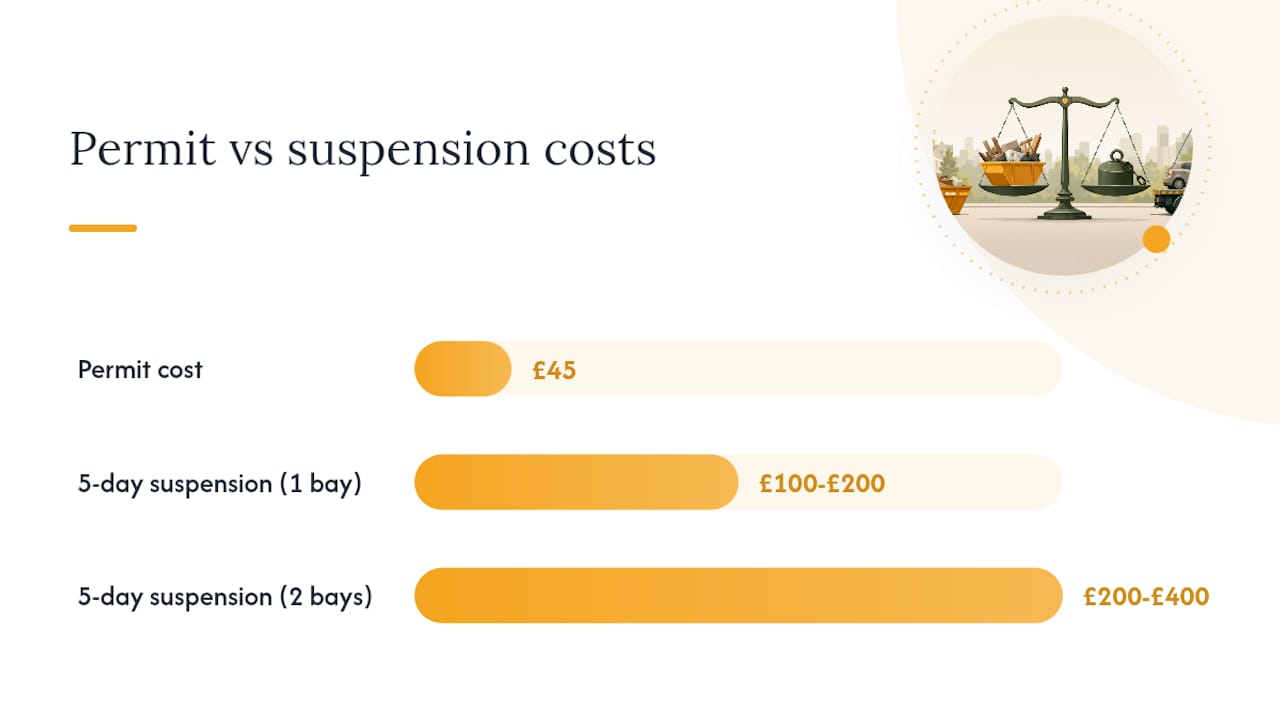
If your skip needs to sit in a marked parking bay, expect a second bill on top of the permit. Councils charge a daily suspension fee per bay affected, plus an administration charge, and these figures compound fast over a multi-day job.
Camden's published schedule shows tiered licence fees alongside separate daily suspension bands that rise the longer the bay stays out of use, and Wandsworth's fee guidance makes a similar point: a suspended parking bay charged per space per day can outstrip the base permit within a week.
- A permit might cost £45, but a five-day bay suspension at £20 to £40 a day can add £100 to £200 on top
- Skips needing two bays (common for larger 8 to 12 yard containers) double the suspension cost
- Always ask whether your skip's footprint requires one bay or more before you get a final price
What safety standards do councils expect on the highway?
Councils are less flexible on safety than on paperwork. Expect to provide, or have your operator provide, the following as standard:
- Red or amber lamps, or reflective markings, visible after dark
- Traffic cones marking the skip's boundary
- Wheel chocks or secure positioning to stop movement
- Clear signage where visibility is limited
Placement rules matter too: skips generally can't sit near junctions, bus stops or pedestrian crossings, and restricted locations usually mean a longer approval window before the council will even consider the permit application, on top of the usual processing time.
What happens if you skip the permit?
A skip placed on the public highway without permission is treated as an obstruction under the Highways Act 1980, and councils have the power to remove it and recover the cost from whoever placed it.
The financial risk is real and immediate. Liverpool's council page cites fixed-penalty notices around £200 for unauthorised placement, and Bristol charges a steeper retrospective licence fee once a skip is already sitting on the highway unpermitted.
- Fixed-penalty notices for unauthorised placement
- Council removal and recovery of costs from the person responsible
- Higher retrospective permit fees applied after the fact, not before
If you've received a notice, contact the council immediately and apply retrospectively rather than leaving the skip in place, delay tends to increase the eventual bill.
How long does a permit last, and how fast can you get one?
Validity periods differ by council. Manchester caps standard permits at seven days, Sheffield allows up to 15 days with cheap extensions, and Bristol works on a rolling calendar-month basis instead of a fixed short window.
- Routine applications: often processed within a few working days
- Restricted locations: expect 10 days' notice or more before approval
- Renewals: usually as simple as reapplying and paying the fee again
Book your skip hire early if your job might overrun the standard window, chasing a same-day extension is far harder than planning ahead.
What should you confirm before booking a skip?
- Who's applying for the permit, you or the operator, and is the fee already in the quote?
- Does the quote include any parking-bay suspension charge, and how many bays does the skip need?
- What's the permit's validity period, and what happens if the job runs over?
- Is public liability insurance in place, and can you get a digital copy of the permit and duty-of-care paperwork for your records?
A publisher's note on when a skip actually makes sense
A full skip makes sense for a genuine renovation clear-out. For a smaller job, one sofa, a bathroom refit's offcuts, the permit and suspension costs above often outweigh the convenience. Binshare exists for exactly that gap: on-demand collection from verified carriers, no permit admin, no bay suspension.
A permit-free route worth considering for smaller jobs
Not every clear-out needs a skip sitting on the road for a week. If you're only shifting a van-load of waste, arranging a permit, working out parking-bay suspension costs, and hitting council notice periods can cost more time and money than the job itself. That's where a different route makes sense.

Binshare connects you with licensed waste carriers through a simple photo-based booking. Snap what needs collecting, get competitive bids from verified operators, and pay securely once the job's done, all without touching council permit paperwork or parking suspensions. Every carrier on the platform is checked for Environment Agency compliance, and you get a digital duty-of-care receipt for your records automatically.
Choose this route when your load is smaller than a full skip, when kerbside space is tight, or when the permit and suspension fees above simply don't add up for the job at hand. Head to Binshare to see what carriers are bidding in your area right now.
Sources
- Apply for a skip permit
- Skip licence - Camden Council
- Skip permit | Manchester City Council
- Apply for a permit to put a skip on the highway
- Skip hire costs in the UK: Pricing breakdown 2026