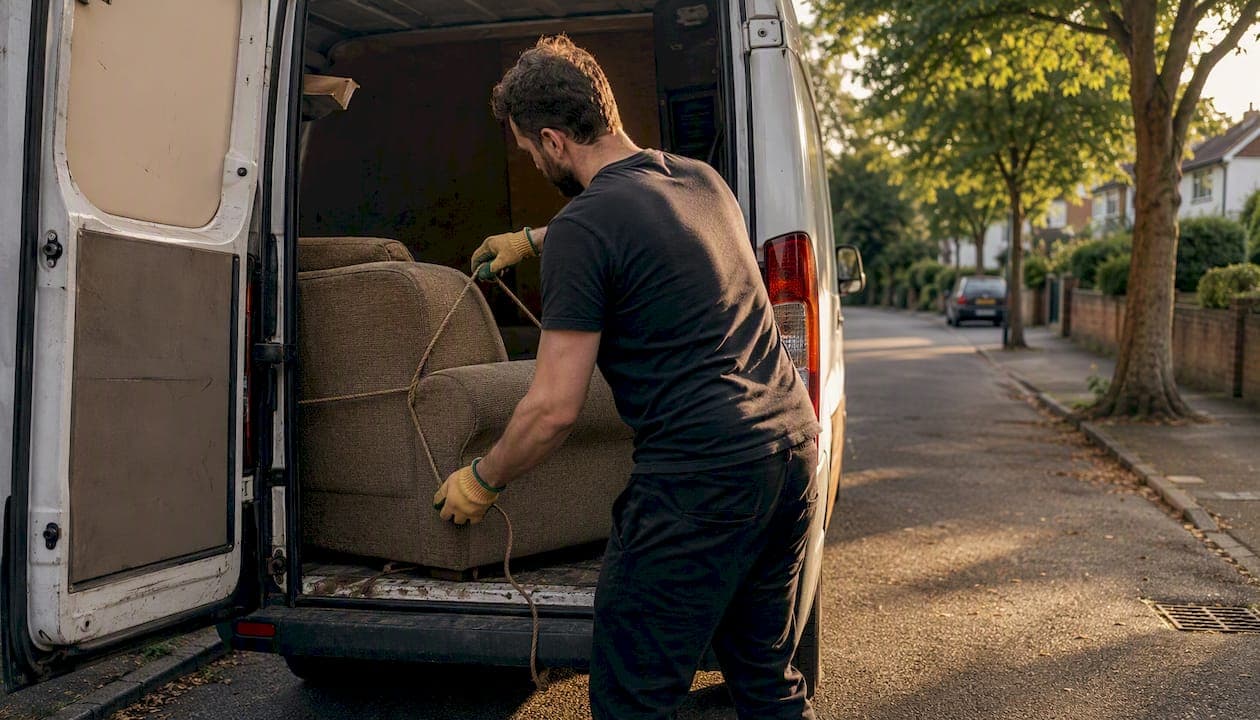
The quickest responsible way to get rid of a sofa in the UK is reuse first: donate it to a charity or list it on a give-away network, and only turn to a paid route if that fails. If your sofa still has its fire-safety label and is in decent nick, a charity such as the British Heart Foundation will often collect it free. No luck there? Book a council bulky-waste collection or use a licensed marketplace like Binshare, which typically gets a verified carrier to your door within days.
Here's what to do right now:
- Check the sofa for its fire-safety label, it's the first thing any charity will ask about.
- List it on Freecycle or Freegle if you're happy to give it away.
- Book a special collection through your council or the Gov if reuse isn't an option.
- Get a quote from a verified carrier through a marketplace such as Binshare if you need it gone fast.
Most councils in England and Wales charge for bulky-item collection, and the fee varies widely depending on where you live, so it pays to compare your free options before you pay for anything.
Key Takeaways
Reuse a resellable sofa first, then use a council or a verified paid carrier when reuse isn't possible, checking the fire label and carrier registration at every step.
| Point | Details |
|---|---|
| Reuse comes first | Check the fire-safety label and try charity donation or Freecycle/Freegle before paying anyone. |
| Council collection costs vary | Book through GOV.UK or your council; fees differ significantly by local authority. |
| Verify any paid carrier | Check Environment Agency registration and get a duty-of-care receipt before payment. |
| Prepare before collection day | Measure doorways, keep the fire label visible, and confirm the collection slot in advance. |
| Choose Binshare for speed | Binshare matches you with verified carriers, secure payment and a digital duty-of-care receipt for fast, compliant removal. |
Table of Contents
- What are the main sofa disposal routes in the UK?
- How do you donate or give away a sofa for free?
- How does council bulky-waste collection work?
- Why choose a licensed marketplace for fast sofa removal?
- Can you take a sofa to a recycling centre yourself?
- What are the legal rules around fire labels and duty of care?
- How do you prepare a sofa for collection?
- What does sofa disposal typically cost and how long does it take?
- Why verified marketplaces matter for bulky waste
- How Binshare gets your sofa collected fast
- Where to check the rules and book a collection
- Frequently asked questions
- Sources
What are the main sofa disposal routes in the UK?
Five realistic paths exist for offloading an old sofa, and they differ sharply on cost, speed and how good they are for the planet. Which?'s consumer guidance lists charity donation, giving away or selling online, recycling centre drop-off, council bulky collection and private removal as the standard toolkit, and it flags reuse as the most sustainable choice whenever your sofa is fit for a second life.
| Route | Cost | Speed | Sustainability |
|---|---|---|---|
| Charity donation | Free | Days to weeks | Highest, direct reuse |
| Give away/sell online | Free | Hours to days | High, direct reuse |
| Recycling centre drop-off | Free (you provide transport) | Same day | Good, materials recovered |
| Council bulky collection | Usually chargeable | Days to weeks | Moderate, mixed outcomes |
| Private/marketplace collection | Chargeable | Same day to a few days | Good, especially with verified carriers |
Charity donation and give-away networks cost nothing but depend on your sofa passing muster, mainly that fire-safety label. Recycling centres are free if you can get the sofa there yourself, which usually means access to a car and roof rack or a van. Council collections are convenient but rarely instant, and fees swing depending on your local authority. Private collection through a marketplace costs the most of the free options but wins on speed and certainty, particularly useful if you're mid house-move or a landlord clearing a property between tenancies.
How do you donate or give away a sofa for free?
Charities will only take a sofa in resellable condition, and the fire-safety label is the gatekeeper. Every upholstered sofa sold in the UK since 1988 must carry a permanent label confirming compliance with fire-resistance regulations, and without it, most charities including the British Heart Foundation won't accept the item for resale. Torn covers, damp, pet damage or missing legs will also get a polite refusal.
If your sofa qualifies, here's the checklist charities typically apply:
- Fire-safety label present and legible, usually stitched under a cushion or on the base.
- No rips, deep stains, mould or persistent odours.
- Structurally sound, no broken frame or missing feet.
- Free of pests, especially important if it's been in storage.
Pro Tip: Photograph the fire label before you call a charity. Most collection teams will ask you to confirm it exists over the phone, and having a picture ready saves an awkward moment on the doorstep when the crew arrives and can't find it.
Give-away networks work slightly differently. Freecycle and Freegle don't apply the same fire-label rule as commercial resellers, since items pass directly between individuals rather than through a shop floor. Even so, honesty about condition matters, because a false listing just wastes everyone's time. Post clear photos from several angles, include exact measurements, and mention whether you can help carry it downstairs. Sofas with a story, "barely used, moving abroad" beat "free sofa" every time for response speed.
How does council bulky-waste collection work?
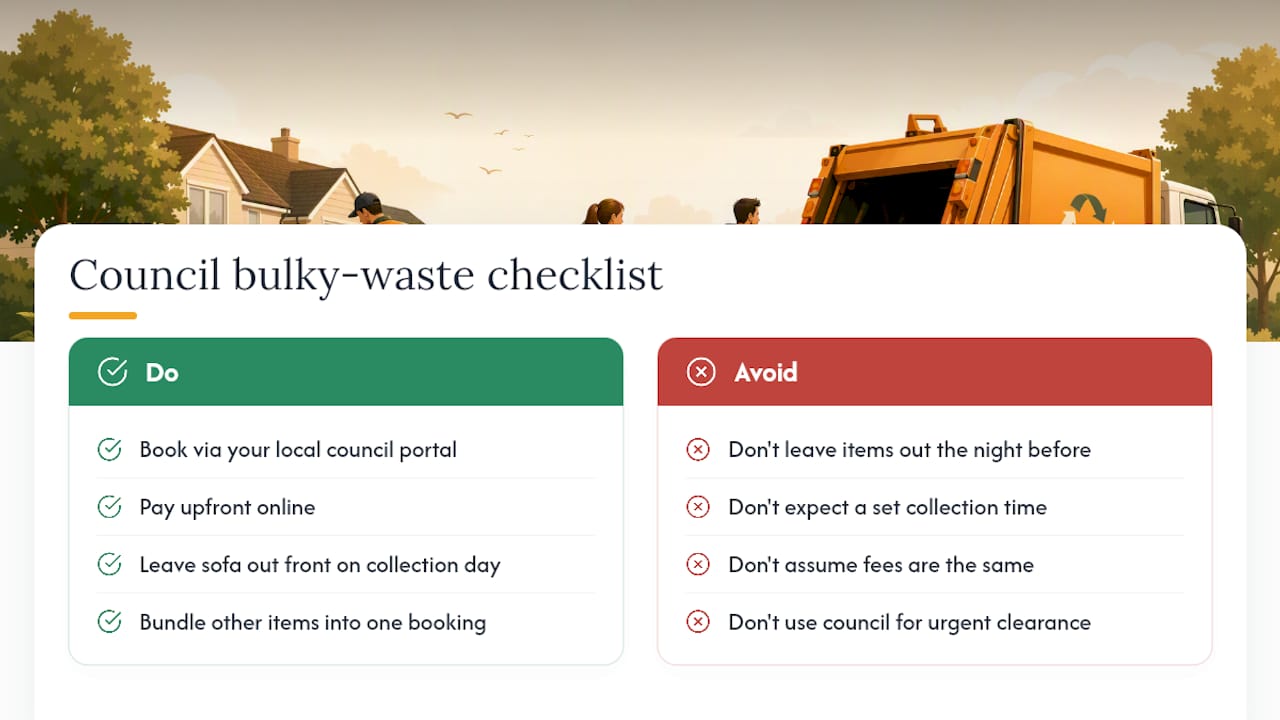
Councils across England and Wales run a special collection service for large items, and you book it either directly with your local authority or via the GOV.UK bulky-waste guidance page, which routes you to the right council portal based on your postcode. You typically request a slot online, pay upfront, and get a fixed collection window, often a specific day rather than a set time.
Fees vary a great deal between councils, and there's no single national rate. Consumer research from Which? points to this variation as one of the biggest frustrations for households trying to plan a clearance, since a next-door borough can charge a noticeably different amount for what is functionally the same job. Some councils bundle multiple items into one fee, which makes it worth clearing out other bulky junk at the same time rather than booking separate collections.
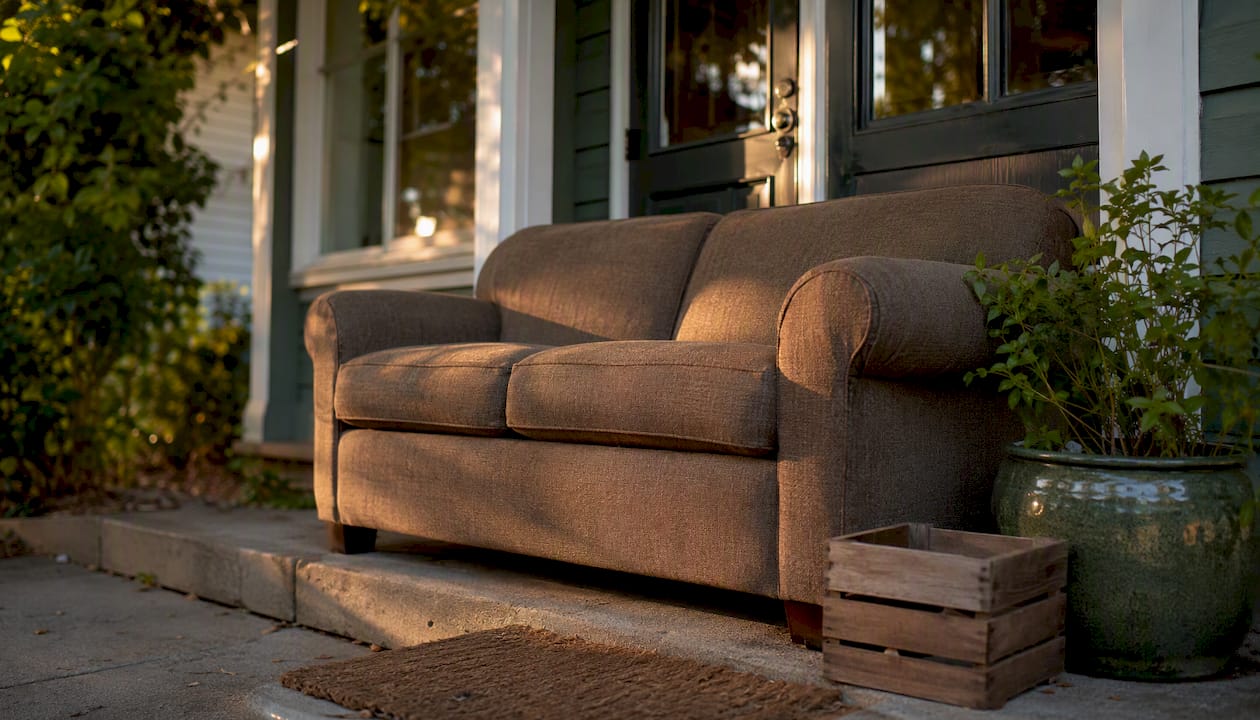
Councils generally won't take items containing certain hazardous materials without extra arrangements, and most ask you to leave the sofa out front on the collection day itself, not the night before, to avoid fly-tipping accusations or fox damage. Lead times often stretch to one or two weeks during busy periods, so if you're on a tight moving deadline, council collection may simply be too slow.
Scotland and Northern Ireland run comparable schemes through their own local authorities rather than the GOV.UK portal, so check your specific council's or district's waste pages directly, as booking systems and fee structures differ from the England and Wales model.
Why choose a licensed marketplace for fast sofa removal?
When reuse and council slots don't fit your timeline, paid private removal is the fallback that actually gets a sofa out of your hallway this week rather than next month. The process through a marketplace such as Binshare works in a few clear steps:
- Photograph the sofa and add a short description, including size and condition.
- Receive competing quotes from verified waste carriers within the app.
- Check the carrier's Environment Agency registration before accepting a bid.
- Confirm collection time and pay securely once the job is booked.
- Receive a digital duty-of-care receipt confirming legal disposal.
That last step matters more than most people realise. Every legitimate waste carrier in the UK must be registered, and you can check any operator against the public waste carriers register before handing over a penny. A registration number that doesn't match, or simply doesn't exist, is the clearest warning sign of an unlicensed operator who might dump your sofa in a layby rather than dispose of it properly, leaving you legally liable under duty-of-care rules.
Look for these signals before booking any private carrier:
- A valid, checkable Environment Agency waste carrier registration.
- Willingness to provide a written or digital duty-of-care receipt.
- Clear, upfront pricing with no vague "we'll see when we get there" quotes.
- Reviews or a verification badge if booking through a marketplace platform.
Private collection prices vary depending on location, sofa size and how quickly you need it gone, but expect to pay more for same-day service than for a booking with a few days' notice. It's worth paying for speed when you're facing a moving-day deadline, a landlord handover, or simply don't want a three-seater blocking your living room for another fortnight.
Can you take a sofa to a recycling centre yourself?
Household waste and recycling centres will usually take a sofa for free, provided you can transport it there yourself. Staff typically separate the frame, foam and fabric into different recycling streams once it arrives, recovering materials that would otherwise go to landfill.
A few practical things to sort out before you load up the car:
- Measure the sofa against your vehicle or trailer, a three-seater rarely fits in a hatchback boot.
- Tie the load down securely if it's going on a roof rack or in an open trailer.
- Check your local centre's rules, since some limit the number of bulky items per visit or require pre-booking a slot.
- Consider whether it needs partial dismantling to fit through the vehicle doors.
Reuse hubs and social enterprises sit in a different category to standard recycling centres. Rather than breaking a sofa down for raw materials, they refurbish and resell it, which keeps more of the original item intact and cuts the energy cost of manufacturing replacement furniture. If your sofa is tired but structurally fine, a reuse hub is the better environmental choice over a standard tip run, since reuse remains the most sustainable disposal method whenever an item still has life left in it.
What are the legal rules around fire labels and duty of care?
The fire-safety label isn't just a charity preference, it traces back to UK furniture fire-resistance regulations, and its absence is the single most common reason a resellable sofa gets turned away. Charities use it as a simple compliance gate: no label, no resale, no free collection.
Separately, GOV.UK guidance on upholstered domestic seating addresses persistent organic pollutants, chemicals once used in some foam and fabric treatments that require specific handling when the item reaches end of life. This mainly affects commercial recyclers and waste processors rather than individual householders, but it explains why some recycling centres and carriers handle sofas differently to, say, a wooden table, and why proper waste-processing routes matter more for upholstered furniture than they might seem to at first glance.
Under UK waste law, anyone who disposes of waste, including a sofa, has a duty of care to ensure it goes to a properly authorised person. That's set out in the Environmental Protection Act 1990, and it's why a licensed carrier should always be able to hand you paperwork confirming they're registered and where the item is going.
Before you pay anyone to take a sofa away, insist on seeing this:
- Their Environment Agency waste carrier registration number.
- A written or digital duty-of-care transfer note once collection is complete.
Pro Tip: Ask for the registration number before the van arrives, not after. A legitimate carrier will give it to you without hesitation, and you can verify it on the public register in under a minute.
How do you prepare a sofa for collection?
A little preparation avoids the most common causes of delay or refusal on collection day, whether it's a charity van or a paid carrier turning up.
- Confirm the fire-safety label is still attached and legible if you're hoping for a free charity collection.
- Measure doorways, hallways and staircases to check the sofa can actually get out without needing to be dismantled.
- Remove loose cushions and covers if the collection team has asked for it, this speeds up loading.
- Wrap or tie the sofa if it's being left outside, protecting it from rain ahead of a council collection.
- Dismantle removable legs or arms on large frames, and label the parts so nothing gets lost.
- Air the item out and check for damp if it's come out of storage, since musty smells are an instant charity rejection.
- Confirm the exact collection time and accepted payment method the night before.
- Place the sofa in the agreed spot, kerbside for council jobs, just inside the door for most private carriers, so the crew isn't hunting for it.
What does sofa disposal typically cost and how long does it take?
Cost and speed pull in opposite directions across the five main routes, so it helps to see them side by side.
| Route | Typical cost | Typical timeline |
|---|---|---|
| Charity donation | Free | Several days to a few weeks |
| Give away (Freecycle/Freegle) | Free | Hours to a few days |
| Recycling centre drop-off | Free (excluding transport) | Same day |
| Council bulky collection | Chargeable, varies by council | One to two weeks |
| Marketplace/private carrier | Chargeable | Same day to a few days |
Council fees vary significantly by local authority, and there's no flat national rate for bulky waste collection, so it's worth checking your specific council's charge before assuming it'll be cheap. If you need the sofa gone today or tomorrow, council collection almost never delivers on that timeline. Charity collections sit at the slower end too, since most operate on scheduled van routes rather than on-demand slots. A verified marketplace carrier is usually the only route that reliably matches urgency with legal compliance.
Why verified marketplaces matter for bulky waste
The biggest risk in sofa disposal isn't cost, it's ending up with an unlicensed operator who takes your money and fly-tips the item down a country lane. That's not a hypothetical: illegal dumping remains a persistent enforcement problem precisely because unregistered "man with a van" operators are cheap and hard to trace once they've driven off. A digital duty-of-care receipt closes that loophole, giving you proof the item went to a legitimate processor rather than a ditch.
There's also a quieter environmental argument for marketplaces that gets overlooked. Matching a carrier who already has a near-full van and a route past your street avoids sending a half-empty vehicle out solely for your sofa, cutting unnecessary journeys and the emissions that come with them. It's a small efficiency multiplied across thousands of collections a week.
If speed and legal certainty both matter to you, and for most people facing a house move or a landlord deadline they do, a verified marketplace is the sensible default rather than a last resort.
How Binshare gets your sofa collected fast
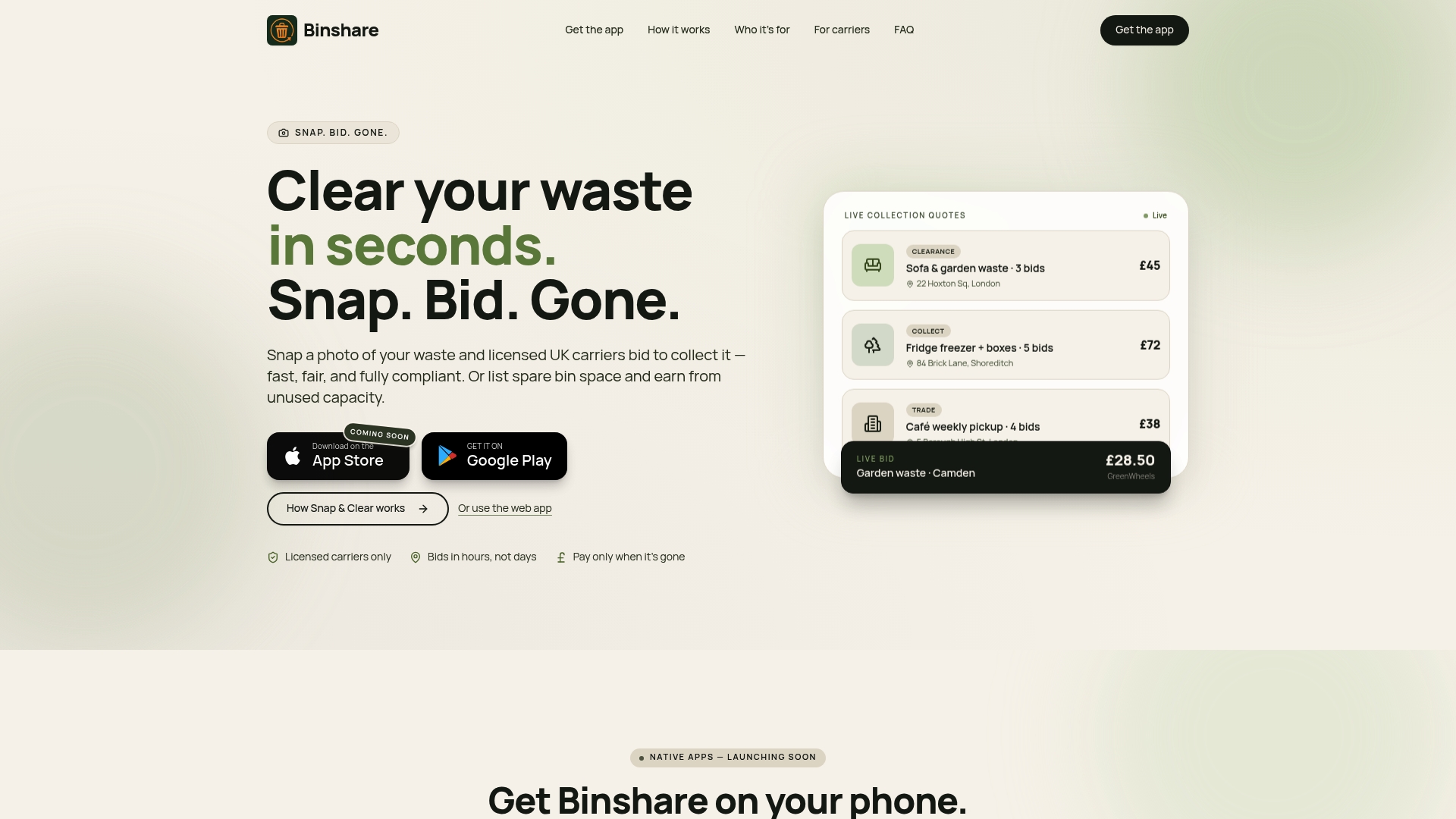
If reuse isn't an option and council waiting times don't suit your schedule, Binshare is built for exactly this moment: a sofa that needs to be gone this week, collected legally, with proof to show for it. Snap a photo, get competing bids from Environment Agency verified carriers, and pick the one that suits your price and timing. Payment happens securely through the app after collection, not before, and you receive a digital duty-of-care receipt confirming the sofa went to a properly licensed processor.
That receipt is your protection against the fly-tipping risk that comes with unverified "cash in hand" collectors, and the carrier verification means you're never guessing whether the number on the side of the van is legitimate. For landlords, letting agents, or anyone clearing a property against a deadline, that combination of speed and paperwork is worth more than shaving a few pounds off a slower council booking. Head to the Binshare marketplace to photograph your sofa and see what carriers in your area are bidding today.
Where to check the rules and book a collection
- GOV.UK bulky-waste collection guidance, the official starting point for booking a council collection in England and Wales.
- Recycle Now's furniture guidance, useful for checking what charities and recycling centres accept.
- Which?'s sofa disposal overview, a broader comparison of methods and typical costs.
- Freecycle, for listing a sofa to give away locally for free.
- Binshare, for a fast quote from a verified licensed carrier when you need paid collection.
- The public waste carriers register, for checking any private carrier's registration before you pay.
- If professional haulage and compliant removal logistics interest you further, the furniture removal resources at HVAC Prime cover how larger-scale furniture transport is typically organised.
Frequently asked questions
Is sofa disposal free in the UK? It can be, if a charity accepts it for resale or you give it away through a network like Freecycle. Council collection and private removal both usually carry a fee, though the exact amount depends on your local authority or chosen carrier.
What happens if I fly-tip a sofa? Illegal dumping is an offence under UK waste law, and duty-of-care obligations mean you can be held responsible even if you paid someone else to take it away, if that person turns out to be unlicensed. Always check a carrier's registration first.
Do charities always take sofas? No. Most require the fire-safety label to still be attached and the sofa to be clean and structurally sound. Without the label, charities generally can't legally resell it.
How quickly can I get a sofa collected through a marketplace? Many verified carriers on platforms like Binshare offer same-day or next-day collection, depending on availability in your area, considerably faster than most council bulky-waste slots.
Sources
- Gov
- Furniture | Recycle Now
- How to get rid of a sofa: 7 best sofa disposal methods - Which?
- Environment public register entry