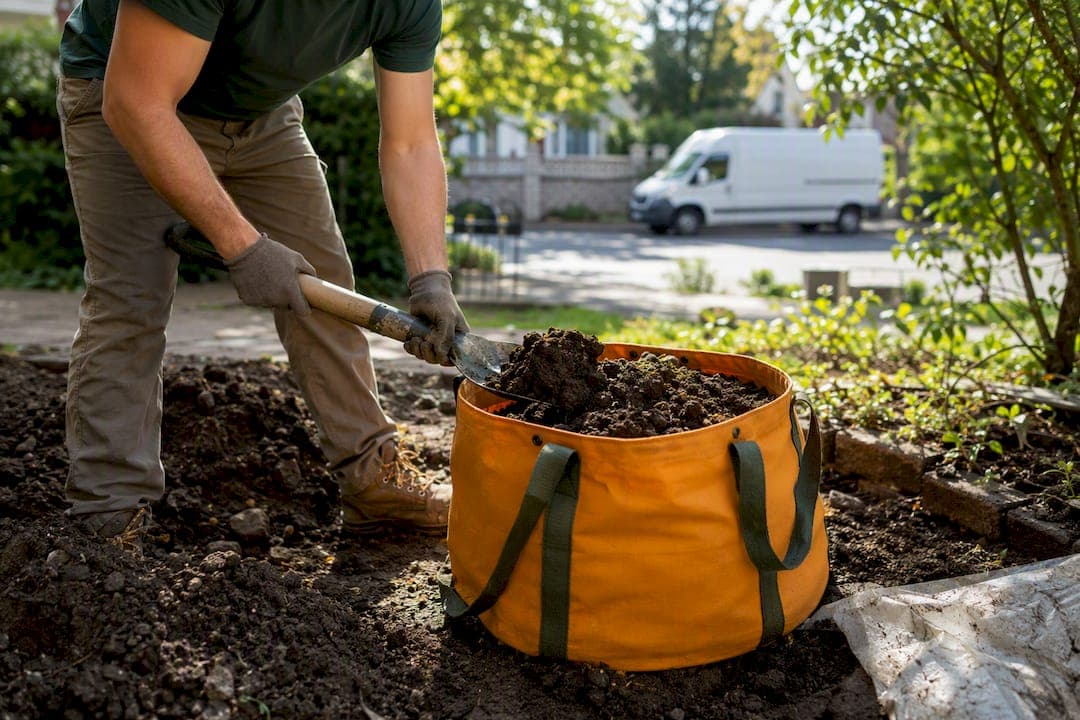
A small skip-load of clean soil typically costs a moderate amount to remove, while a full lorry load or a contractor-scale job for an extension can cost substantially more once tipping fees and haulage are factored in. Prices swing hard by postcode: some councils accept limited soil free at the local recycling centre, others charge per bag or refuse it outright. Before you book anything, check your local authority's rules for construction waste, then get more than one quote so you're comparing like for like.
- Small DIY loads (a few bags, garden clearance): often a modest charge
- One skip or bag load (1 to 4 tonnes): a moderate charge
- Contractor or extension-scale volumes (multiple loads): significantly higher charges
- Fastest route to a fair price: photograph the soil and get competitive bids from verified carriers through a platform like Binshare
Key Takeaways
Soil disposal cost in the UK depends more on postcode, access and contamination status than on any single national average figure.
| Point | Details |
|---|---|
| Cost bands vary by volume | Small DIY loads often cost a modest charge; contractor-scale jobs can face significantly higher charges. |
| Postcode rules differ sharply | Council recycling centres apply their own limits and fees, so always check locally before assuming a free drop-off. |
| Contamination multiplies cost | Suspect soil needs testing first, since mixed or hazardous classification pushes tipping fees up significantly. |
| Reuse beats disposal | On-site reuse or reuse partners like Harvest Hub cost nothing and keep soil out of landfill entirely. |
| Compare verified bids | Binshare lets you photograph soil, receive competitive bids from Environment Agency verified carriers, and get a digital duty-of-care receipt automatically. |
Table of Contents
- What drives soil disposal cost: per load, per tonne and per cubic metre
- Which disposal method suits your project?
- Which factors most change what you'll be charged?
- When does soil need testing before disposal?
- The cheapest lawful ways to get rid of soil
- How do you get an accurate, compliant quote?
- A step-by-step checklist for booking soil disposal
- What UK law actually requires when you dispose of soil
- Staying safe when you're moving soil yourself
- What happens if soil is disposed of the wrong way
- How long does soil disposal actually take?
- Practical ways to cut the cost further
- Regulated disposal versus the real cost of cutting corners
- What the postcode lottery really tells you
- Get verified quotes for soil disposal through Binshare
- Sources
What drives soil disposal cost: per load, per tonne and per cubic metre
Carriers quote in three main ways, and knowing which one you're being charged helps you spot a bad deal. Per load is the simplest: a flat fee for a skip, bag or van run, usually the easiest for homeowners to budget against. Per tonne is common with haulage firms and landfill sites, because tipping fees themselves are charged by weight. Per cubic metre shows up in landscaping and excavation quotes, since that's how volume gets measured on site before it's dug out.
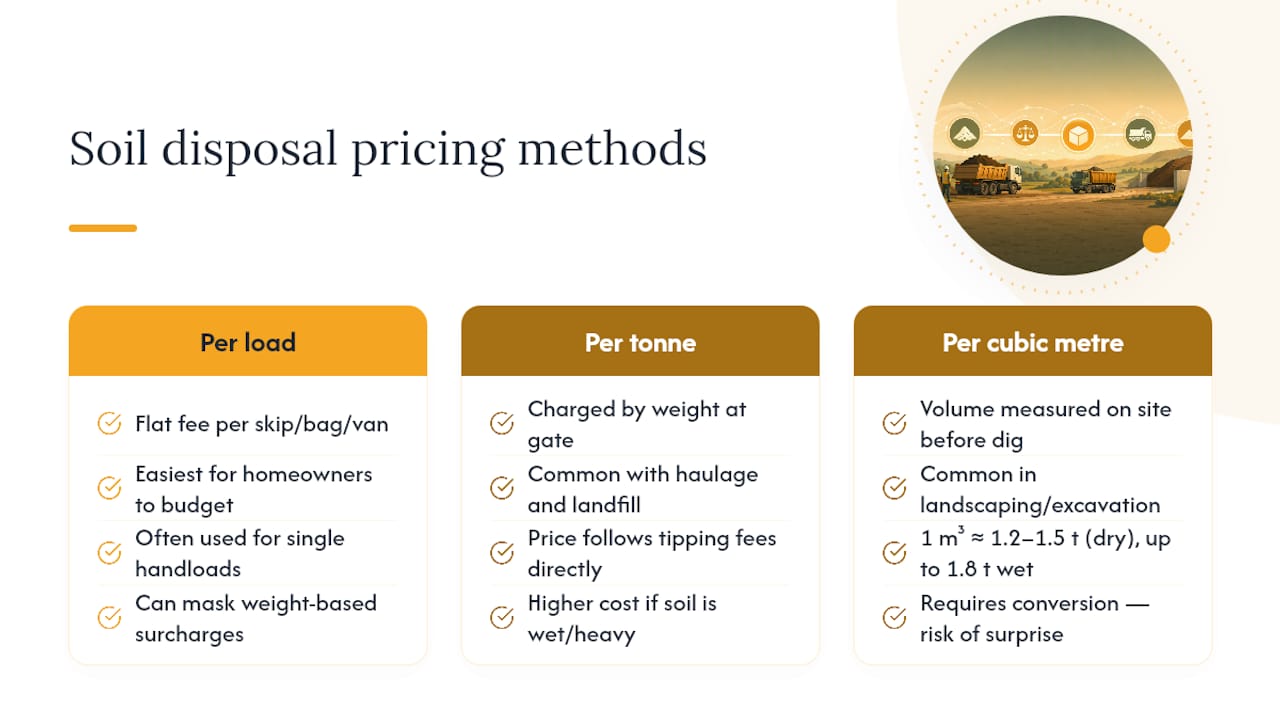
The conversion between these units catches people out constantly. A cubic metre of dry topsoil weighs roughly 1.2 to 1.5 tonnes, but wet clay soil after a rainy fortnight can push closer to 1.8 tonnes. That difference matters because tipping fees are charged on the weight that arrives at the gate, not the volume you estimated at home.
A single handload of garden soil might cost a modest amount to remove, one hippobag or skip load usually costs more, and a contractor clearing several tonnes from an extension dig can face considerably higher costs depending on distance and site access. Published international benchmarks show similarly wide ranges, which is exactly why a generic figure from a US or global source should only be used as a rough sanity check, never a quote.
Mixed waste changes everything. Soil contaminated with rubble, plastic, or worse, gets reclassified and reclassification usually multiplies the tipping fee.
Which disposal method suits your project?
Every route trades cost against effort, and the right one depends on how much soil you've got and how quickly you need it gone.
- On-site reuse: levelling low patches, building raised beds or backfilling around foundations costs nothing beyond your own labour, and it's the first option worth considering for any project.
- Council recycling centres: many accept small domestic quantities free or for a nominal charge, but this is genuinely a postcode lottery. Some sites cap you at a boot-load, others won't take construction-derived soil at all, so check your local recycling centre's rules before you load the car.
- Hippobags and midibags: these hold roughly 1 to 1.5 tonnes depending on size and are frequently cheaper than a full skip for a homeowner clearing a border or small patio.
- Skip hire and professional haulage: worth it once you're dealing with multiple tonnes, restricted access, or a contractor timeline where waiting for a council slot isn't practical.
Which factors most change what you'll be charged?
- Volume and moisture. Wet soil weighs noticeably more than dry soil of the same volume, and since haulage and tipping fees are usually weight-based, a rainy week before collection can quietly inflate your bill.
- Site access and loading time. Narrow driveways, steps, or a soil pile that's a long carry from the road all add labour time, and most carriers build a minimum mobilisation fee into the quote regardless of how small the job is.
- Distance to an authorised disposal site. Rural postcodes with fewer licensed facilities nearby often pay more in haulage than urban areas with a tip a few miles away.
- Contamination or debris. Rubble, brick, plastic sheeting or anything suggesting a fuel spill can tip clean soil into the mixed or hazardous waste category, and that reclassification is where costs escalate fastest.
When does soil need testing before disposal?
Not every load needs a lab test, but certain site histories make it essential rather than optional.
- Land with a known industrial or agricultural past
- Sites where fuel tanks, oil stores or workshops previously stood
- Demolition projects generating rubble mixed in with the soil
- Anywhere near a former petrol station, garage or contaminated watercourse
Basic soil testing for a domestic or small commercial job generally costs a moderate sum and provides results within a few working days, which can be worthwhile compared to potential higher costs from rejected soil loads. Contamination usually multiplies the eventual disposal fee, because it forces a switch to a licensed hazardous or mixed-waste facility rather than a standard clean-fill site.
The cheapest lawful ways to get rid of soil
Reuse beats disposal every time it's possible, both on cost and on environmental grounds. Levelling a lawn, filling raised beds, or building up a border all use soil that would otherwise cost money to remove.
- Ask neighbours or local allotment holders. Community demand for free topsoil is usually stronger than people expect.
- Try a reuse marketplace or compost partner. Harvest Hub's compost and reuse listings connect people with surplus soil to others who want it, cutting out landfill entirely.
- Post it as free on local community boards, but only after checking it for weeds, rubble or contamination first, since handing over compromised soil can land you in a dispute later.
Pro Tip: Photograph the soil pile and note its origin (turf, subsoil, builder's rubble mixed in) before offering it free. It saves an awkward conversation when someone turns up expecting clean topsoil and finds clay full of brick fragments.
How do you get an accurate, compliant quote?
Getting a quote that actually holds up on the day means giving carriers the full picture upfront, not after they've arrived.
- Estimate your volume honestly in cubic metres or tonnes, and flag anything unusual: mixed rubble, suspected contamination, or restricted access.
- Take clear photos of the pile and the access route. Vague descriptions are the single biggest cause of quotes changing on collection day.
- Verify the carrier's credentials. Ask for their Environment Agency waste carrier registration and confirm where the soil is actually going.
- Request duty-of-care paperwork at the point of booking, not as an afterthought once the job's done.
Pro Tip: A carrier who hesitates when you ask for their waste carrier licence number is a red flag, walk away and find one who answers immediately. Binshare builds this verification into the platform itself: carriers are checked before they can bid, and every completed job generates a digital duty-of-care receipt automatically, so you're not chasing paperwork after the fact.
A step-by-step checklist for booking soil disposal
- Estimate and classify. Work out roughly how many tonnes or cubic metres you have, and be honest about whether it's clean soil, mixed with debris, or from a site with a contamination risk.
- Check your council's rules. Local recycling centre policies vary by postcode, so a five-minute check can save a wasted trip.
- Get at least two quotes. Compare like for like, confirm each carrier is verified, and ask what's included (loading, haulage, tipping fee) versus what's extra.
- Confirm the duty-of-care receipt. Keep it on file. If your soil is ever questioned later, this is your proof it was disposed of legally.
What UK law actually requires when you dispose of soil
Soil isn't automatically "clean" just because it looks like garden dirt, and that's the single most misunderstood point in domestic waste disposal. Under the government's waste classification guidance, construction and demolition material, which includes excavated soil, must be correctly classified before it leaves your site, and the person arranging removal carries a legal duty of care to ensure it ends up somewhere licensed to accept it.
That duty of care doesn't disappear once the soil's in someone else's van. If a carrier isn't registered with the Environment Agency and dumps your soil illegally, you can still be traced back as the original waste producer. This is why asking for a carrier's registration number isn't box-ticking, it's the difference between a legitimate transaction and a liability that follows you home.
The technical classification framework, known as WM3, sets out how to test and categorise waste, including when soil needs assessment before it's accepted at a facility. Councils apply their own variations on top of this national framework, which is exactly why the same load of soil might be accepted free at one recycling centre and refused outright at another twenty miles away. Always confirm the specific rules for your postcode before loading the car or booking a skip, rather than assuming what worked for a neighbour will work for you.
Keeping the duty-of-care documentation isn't optional paperwork, it's your evidence trail if anyone ever questions where the soil went.
Staying safe when you're moving soil yourself
Manual handling injuries are the most common risk on any small soil removal job, and they're also the most preventable. A single bucket of wet soil can weigh considerably more than the same bucket dry, and lifting from an awkward angle, bent over a border or reaching into a skip, is where backs give out.
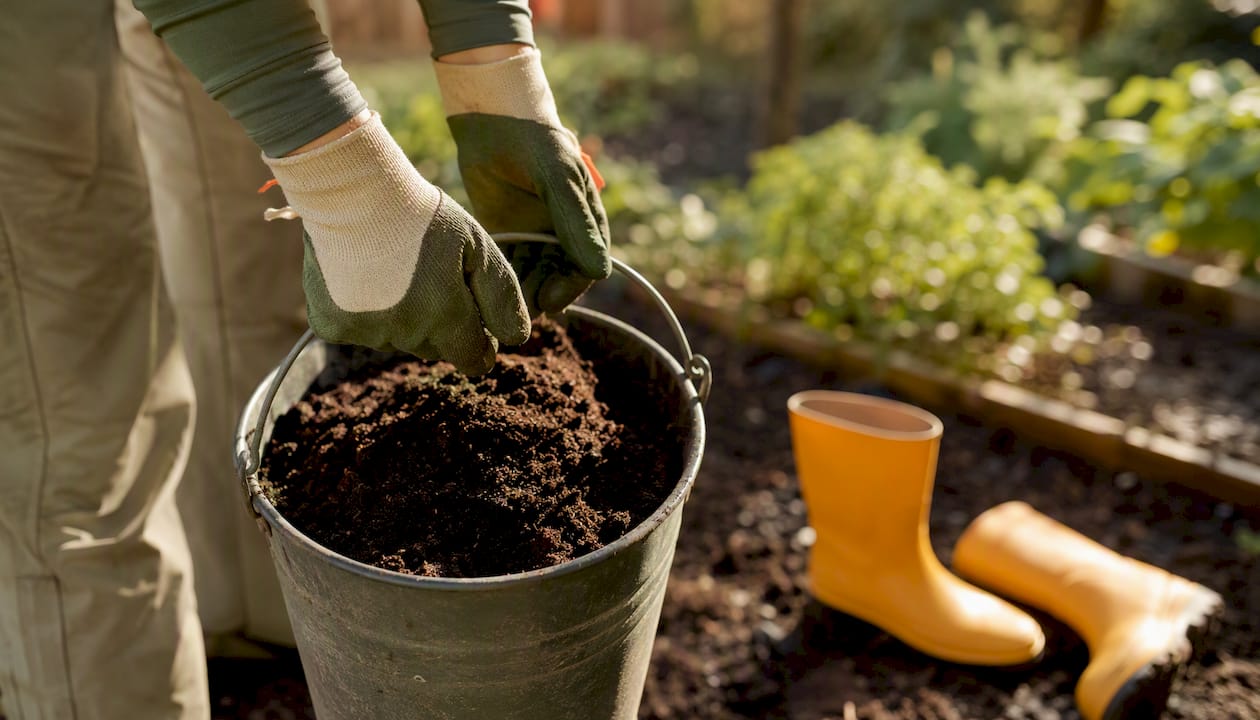
Work in smaller loads than feels efficient. Bagging soil into manageable amounts and making more trips beats one heroic effort that leaves you unable to finish the job. If you're filling a hippobag or midibag yourself, keep it on level ground and don't overfill it beyond the stated capacity, an overloaded bag can split or become too heavy for the collection vehicle's lifting gear.
Soil from an unknown history carries its own hazard. Old garden soil can harbour sharp debris, broken glass or old fencing wire buried from years back, and demolition-adjacent soil can carry dust from materials like old plasterboard. Gloves and sturdy boots aren't overkill for what looks like a simple gardening job.
If you're working near excavation, be alert to trench collapse risk, even a shallow trench can be more dangerous than it looks, particularly in wet or sandy ground. And if there's any suspicion of contamination, fuel smell, unusual staining, debris from an old outbuilding, stop and get it assessed before you or anyone else handles it further. The cost of a test is nothing compared with a health scare from unknowingly handling contaminated ground.
What happens if soil is disposed of the wrong way
Fly-tipped soil doesn't just vanish once it's dumped in a layby or field corner, it sits there leaching into groundwater, smothering vegetation, and in the case of contaminated material, potentially spreading whatever was in it into the surrounding land. Clean-up of fly-tipped waste falls to landowners or local authorities, and the cost of that clean-up is often far higher than the original disposal fee would ever have been.
The legal liability doesn't end when the soil leaves your possession, either. Under the duty-of-care principle set out in GOV.UK's waste guidance, if you hand soil to an unlicensed carrier and it's later found dumped illegally, you can be held responsible as the original producer, regardless of what the carrier told you at the time. That's a genuinely uncomfortable position to be in, and it's entirely avoidable by checking credentials before you hand anything over.
There's a slower, quieter cost too. Soil contaminated with fuel residue, heavy metals or building chemicals that ends up on land it shouldn't be on can affect what grows there for years, and remediating contaminated land is a specialist, expensive undertaking. What looks like a shortcut on a Tuesday afternoon can become someone else's multi-year problem, sometimes literally in their own garden.
None of this means soil disposal has to feel fraught. It means treating the paperwork and the carrier check as part of the job, not an optional extra you skip when you're in a hurry.
How long does soil disposal actually take?
For a small domestic job, clean soil with no contamination concerns, expect the whole process from quote to collection within a few days to a week, particularly if you're using a marketplace model where carriers bid quickly rather than a traditional callback-and-quote cycle.
Council recycling centre drop-offs are often same-day, assuming you can transport the soil yourself and the site accepts what you're bringing. That's the fastest route when volumes are small enough to fit in a car boot or trailer.
Larger contractor jobs, or anything requiring testing first, take longer. Lab testing typically adds several working days to the timeline before you even get a disposal quote, since carriers need to know what they're dealing with before they'll commit to a price or a destination site. Add booking a skip or arranging haulage on top, and a contaminated or uncertain load can easily stretch to two or three weeks from first phone call to final collection.
Access and weather also play a role most people don't anticipate. A wet week can delay loading if the ground's too soft for a vehicle to get close, and some tips restrict certain waste types on particular days. Building a little slack into your project timeline for soil removal, rather than assuming it'll happen the moment you're ready, avoids the scramble that leads to rushed, uncompliant decisions.
Practical ways to cut the cost further
Beyond choosing the cheapest disposal method, a handful of habits make a real difference to the final bill. Separating soil from rubble and debris at the point of excavation, rather than letting it all go into one pile, keeps the clean fraction classified as clean and avoids the whole load being priced as mixed waste.
Timing matters more than people think. Booking collection for a dry spell, where possible, keeps the weight down and avoids paying tonnage rates on soil that's absorbed a fortnight of rain. If your project timeline has any flexibility at all, this alone can shave a meaningful amount off a per-tonne quote.
Consolidating loads is another lever. A single larger collection is almost always cheaper per tonne than several small ones, because you're not paying the minimum mobilisation fee multiple times over. If you're working with a contractor on a phased project, ask whether soil from different stages can be stockpiled and collected together.
Finally, don't skip the comparison step. Getting multiple bids, rather than accepting the first quote, is consistently where the biggest savings come from, and a verified-bid marketplace makes that comparison fast rather than a morning of phone calls. Community reuse, checked and offered responsibly, remains free, and should always be the first option considered before any paid route.
Regulated disposal versus the real cost of cutting corners
A licensed disposal route with proper paperwork will almost always look more expensive on the invoice than an informal arrangement, a mate with a van, a cash-in-hand collection, no questions asked. That price gap is precisely why illegal dumping persists, and precisely why it's such a bad trade.
Fly-tipping enforcement in the UK carries serious penalties, and beyond the legal risk, the duty-of-care principle means the person who arranged disposal can be pursued even when someone else physically dumped the waste. The few hundred pounds saved on a dodgy quote can turn into a legal problem, a fine, or a clean-up bill many times larger than the original job would have cost.
Regulated sites and verified carriers also protect you from a quieter risk: the receiving facility rejecting the load on arrival because it wasn't classified correctly. That rejection doesn't just cost time, it often means the carrier charges again to take the soil elsewhere, effectively doubling your fee. Paying for proper classification and a licensed carrier upfront is cheaper, in almost every real scenario, than the cascade of costs that follows a rejected or illegally dumped load.
What the postcode lottery really tells you
The most honest thing anyone can say about soil disposal cost in the UK is that the national averages are close to useless for planning your actual budget. Two homeowners a few miles apart, both clearing a similar volume of clean topsoil, can face wildly different bills simply because one council's recycling centre takes soil free and the neighbouring one charges by the bag or refuses it altogether.
Conventional advice tends to treat this as a footnote. It shouldn't be. The postcode variation is the story, not a caveat to it. Anyone budgeting for a landscaping job or an extension dig who skips the local council check first is planning against a number that may not apply to them at all.
What the reader should prioritise is sequence, not shopping around endlessly for the lowest headline price. Check your council's specific rules first, since that determines whether free or near-free disposal is even on the table. Only after that's ruled out does comparing carrier bids become the lever worth pulling, and that's where a verified marketplace earns its place, not as a replacement for checking your council, but as the fastest way to compare real, accountable quotes once you know reuse and free routes are exhausted. Speed and paperwork matter here as much as the number on the quote. A cheap carrier with no licence and no duty-of-care receipt isn't actually cheap, it's a liability wearing a lower price tag.
— Ynyr
Get verified quotes for soil disposal through Binshare
Binshare is the quickest way to turn "how much will this cost me" into an actual answer, without ringing round five skip firms or guessing at council rules. Photograph your soil pile, add a few details about volume and access, and licensed carriers bid competitively for the job, usually within minutes rather than days.

Every carrier on the platform is verified against Environment Agency registration before they can bid, so you're not left checking licence numbers yourself or hoping a cash-in-hand arrangement doesn't come back to bite you later. Once the job's done, payment happens securely through the app and you receive a digital duty-of-care receipt automatically, the exact paperwork you'd need if anyone ever questioned where your soil ended up. It also works the other way: if you've got spare bin or skip space going unused, you can list it and earn from it while helping someone else dispose of their soil more cheaply. Get a quote through Binshare before your next load leaves the site.