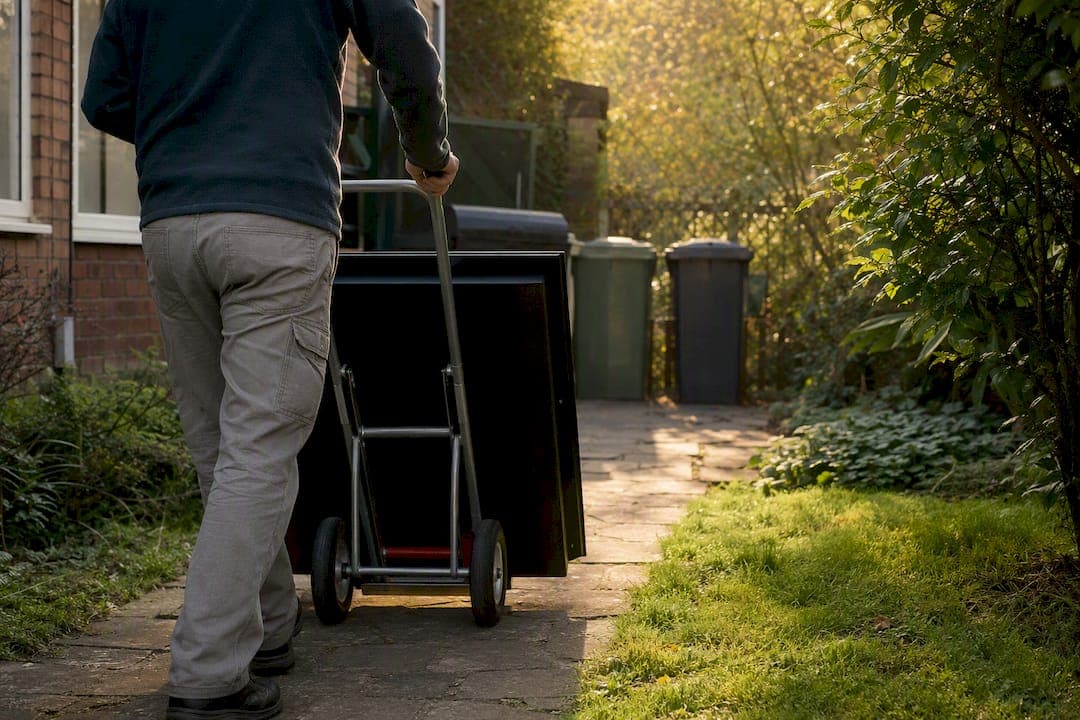
Never put a TV in your household bin. It's classed as WEEE (Waste Electrical and Electronic Equipment) and putting it out with general rubbish is illegal in the UK. Instead, pick one of five legal routes: drop it at a recycling point, book a council bulky-item collection, use a retailer's haul-away service, donate or sell it if it still works, or arrange a licensed carrier to collect it from your door.
Start with the Recycle Your Electricals locator. There are almost 30,000 drop-off and reuse points across the UK, and roughly 75% of the materials inside an old TV can be recycled or reused. If your set has a smashed screen or it's an old CRT model, extra steps and possibly a charge may apply.
- Drop-off point or bring bank (free, fastest for working transport)
- Council bulky-item collection (small fee, booked online)
- Retailer haul-away (often free with a new TV purchase)
- Donation or resale (best for working sets)
- Licensed carrier collection (for heavy, broken or CRT sets)
Key Takeaways
Reuse a working TV before recycling it, and never send any set, working or broken, to general household rubbish.
| Point | Details |
|---|---|
| Check the locator first | Search Recycle Your Electricals for one of almost 30,000 UK drop-off points near you. |
| Council collection needs booking | Use Gov to book a bulky-item slot; fees vary by area. |
| Retailers help with new purchases | Haul-away is often free when a new TV is delivered, but check size limits first. |
| Reuse beats recycling | Donate or sell a working set through charities, repair cafes or local marketplaces. |
| Difficult sets need specialist help | Binshare connects you with verified carriers for broken, heavy or CRT TVs, with a digital duty-of-care receipt included. |
Table of Contents
- How do I find TV recycling services UK-wide?
- Can my council collect an old TV for me?
- Will a retailer take my old TV when I buy a new one?
- Should I donate, sell or repair my TV instead?
- How do I prepare a smart TV before handing it over?
- What about broken screens, CRTs or huge sets?
- How does Binshare handle a difficult TV collection?
- Where can I find more official guidance?
- What UK households consistently get wrong about TV disposal
- Get a verified carrier to collect your TV through Binshare
- Frequently asked questions
- Sources
How do I find TV recycling services UK-wide?
Your nearest Household Waste Recycling Centre (HWRC) almost certainly takes TVs, and most council-run bring banks do too. The quickest way to check is Recycle Your Electricals' locator, which lets you search by postcode and shows exactly which centres near you accept televisions, along with opening hours and whether you need to book a slot.
Most centres take both flat-screen LCD and LED TVs and older CRT sets, though CRTs are often directed to a separate skip because of the leaded glass inside. Some sites cap the number of large electricals you can drop off per visit, and a handful ask you to unload items yourself rather than leaving them with staff.
- Check the locator for your nearest site and any booking requirement.
- Remove remotes, cables and any detachable stands before you leave home.
- Wrap the screen in an old blanket or bubble wrap if it's not already boxed.
- Take a second person if the TV is over about 32 inches. Screens are awkward, not just heavy.
- Confirm the site accepts CRTs if that's what you're disposing of. Not every bring bank does.
Pro Tip: Measure your car boot before you load a large TV. A 55 inch flat screen is lighter than it looks, but it's often wider than a typical hatchback boot opening, and you don't want to be wrestling with it in a car park.
Can my council collect an old TV for me?
Yes. Most local authorities run a bulky waste or special collection service that will take large electricals like TVs straight from your doorstep, and you can find your council's version through Gov. You typically book online, choose a date, and leave the TV out on the morning of collection.
- Fees and rules vary by council. Some charge a flat rate per item, others per collection visit.
- You'll usually need to prove residency, and many councils cap the number of items per booking.
- This route suits people without a car or anyone disposing of several items at once alongside the TV.
- If you need the item gone urgently, or you need documented proof of lawful disposal, a licensed carrier or marketplace booking is usually faster than waiting for a scheduled council slot.
Will a retailer take my old TV when I buy a new one?
Major electrical retailers commonly offer in-store recycling for smaller sets and haul-away collection when they deliver a new one, though Currys' recycling terms show these services come with size and condition limits worth checking first.
- Haul-away is usually free when it's tied to buying and delivering a replacement TV.
- Recycling an old set without a new purchase sometimes attracts a small fee or stricter size caps.
- Always confirm the size limit and booking process before assuming your set qualifies.
- Ask for a receipt or confirmation of collection if you need proof the TV was recycled responsibly, particularly for landlords or business premises.
Should I donate, sell or repair my TV instead?
If the screen still works, recycling should be your last option rather than your first. Recycle Your Electricals and Material Focus both treat reuse, through repair or donation, as the better environmental outcome compared with sending a working set straight for recycling.
- Local charity shops and reuse organisations often accept working TVs, though many won't take CRT sets or anything with cosmetic damage.
- Community Facebook groups, Freecycle and local marketplace listings work well for slightly older but functioning sets.
- A repair cafe or independent TV repairer can fix a common fault (a dead backlight, a failed power board) for far less than a replacement costs.
- List the make, model, screen size and any known faults honestly. It saves you awkward conversations later.
Pro Tip: A photo of the TV switched on, showing a normal picture, does more to reassure a buyer or charity than three photos of it switched off.
How do I prepare a smart TV before handing it over?
Smart TVs store logins, app data and sometimes payment details, so treat them a little like an old phone before you let them go.
- Go into settings and do a full factory reset to clear stored accounts and Wi-Fi details.
- Sign out of any streaming apps individually if the reset doesn't cover them.
- Gather the remote, power cable and any wall-mount brackets so the buyer or recycler gets the full set.
- Tape over a cracked screen to stop shards falling out in transit, and photograph the TV so you have a record of its condition and model number.
Pro Tip: Write the make, model and serial number down before you let the TV go. It takes thirty seconds and it's the first thing a repairer, charity or recycler will ask for.
What about broken screens, CRTs or huge sets?
A shattered screen or an old CRT television isn't something to handle casually. CRTs contain leaded glass and phosphor coatings that need specialist processing, which is why many recycling centres route them to a separate skip rather than the general electricals bin, as Recycle Now confirms for all plug, battery or cable items.
- Don't attempt to transport a broken screen loose in a car boot. Glass fragments and internal components can be a genuine cutting hazard.
- Ring your council to check whether bulky collection covers CRTs, since some services exclude them.
- For very large sets, a licensed carrier collection from your door is usually the safest bet, sometimes with a specialist handling fee attached.
How does Binshare handle a difficult TV collection?
Not every TV disposal fits neatly into a drop-off trip or a council slot, particularly a cracked 65 inch set with no working legs and no car big enough to move it. Binshare connects you with licensed waste carriers who bid on the job after you upload a photo, so you're never guessing whether a random van driver is actually compliant.
- No vehicle or no way to lift a heavy set safely.
- A broken screen or CRT that needs specialist handling.
- A landlord or business that needs a documented duty-of-care record for compliance.
Every carrier on the platform is verified against Environment Agency standards, and each completed job generates a digital duty-of-care receipt, giving you the same kind of paperwork a council collection would, without the wait for a scheduled slot.
Booking a verified carrier through an app rather than hoping a stranger with a van is properly licensed closes a real compliance gap for households disposing of large electricals.
Pro Tip: Keep the duty-of-care receipt from any TV collection for at least two years, particularly if you're a landlord clearing a rental property between tenants.
Where can I find more official guidance?
- Recycle Your Electricals for locating your nearest drop-off point.
- Recycle Now for a full list of accepted electrical items.
What UK households consistently get wrong about TV disposal
Most advice on this topic jumps straight to recycling, as though a TV's only two states are "working in your living room" or "in a skip." That's the gap worth closing. A television with a dead backlight or a faulty power board isn't rubbish, it's a repair job, and treating it as recycling waste from day one throws away a set that a repair cafe could fix in an afternoon.
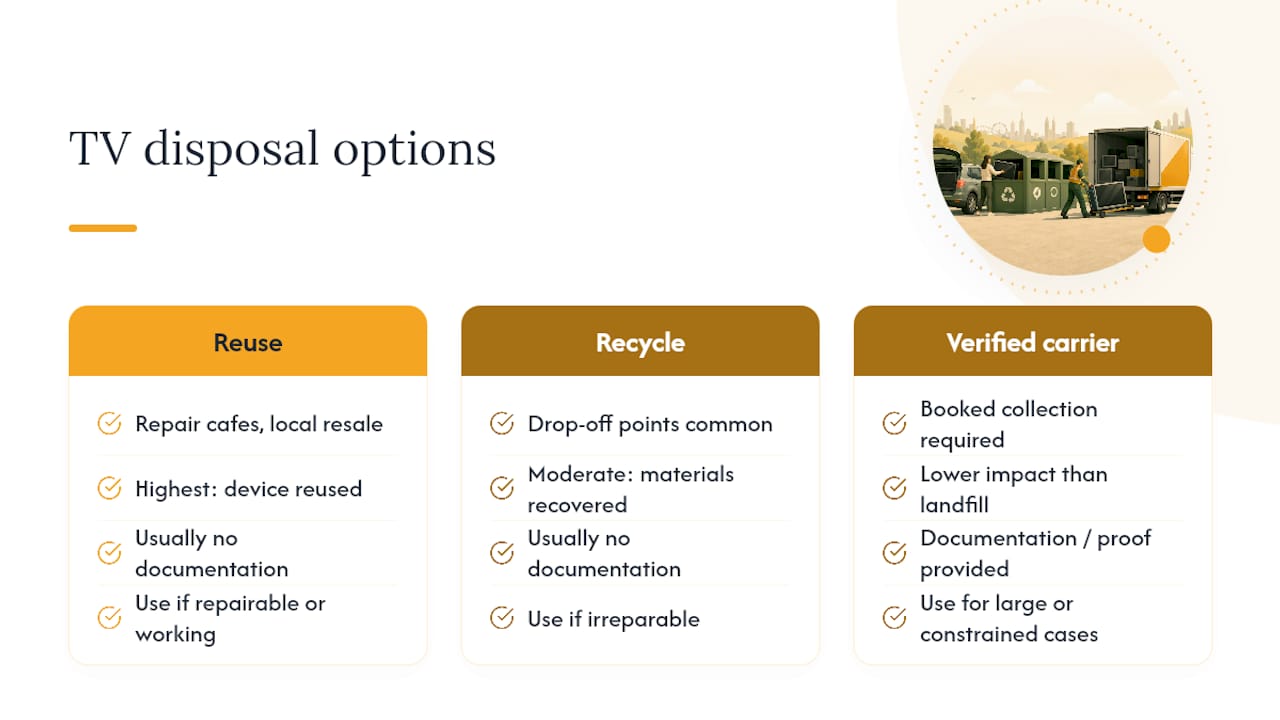
The other blind spot is assuming every disposal route is equally accessible. Drop-off points work brilliantly if you've got a car and a working TV. Council collections work if you can wait for a scheduled date. Neither helps much if you're dealing with a cracked 60 inch screen, no vehicle, and a landlord asking for proof it was disposed of properly. That's a narrower problem than most guides admit, and it's exactly where a verified carrier booking earns its place alongside the free options rather than instead of them.
Prioritise reuse first, recycling second, and reach for a documented carrier collection only when the free routes genuinely don't fit your situation.
Get a verified carrier to collect your TV through Binshare
Binshare is the practical option when a recycling centre trip or a council booking simply doesn't fit your situation, whether that's a broken screen, no vehicle, or a landlord needing proof of lawful disposal. Instead of ringing round local firms and hoping one is properly licensed, you post a photo of the TV on the Binshare marketplace and receive competitive bids from carriers already verified against Environment Agency compliance standards.
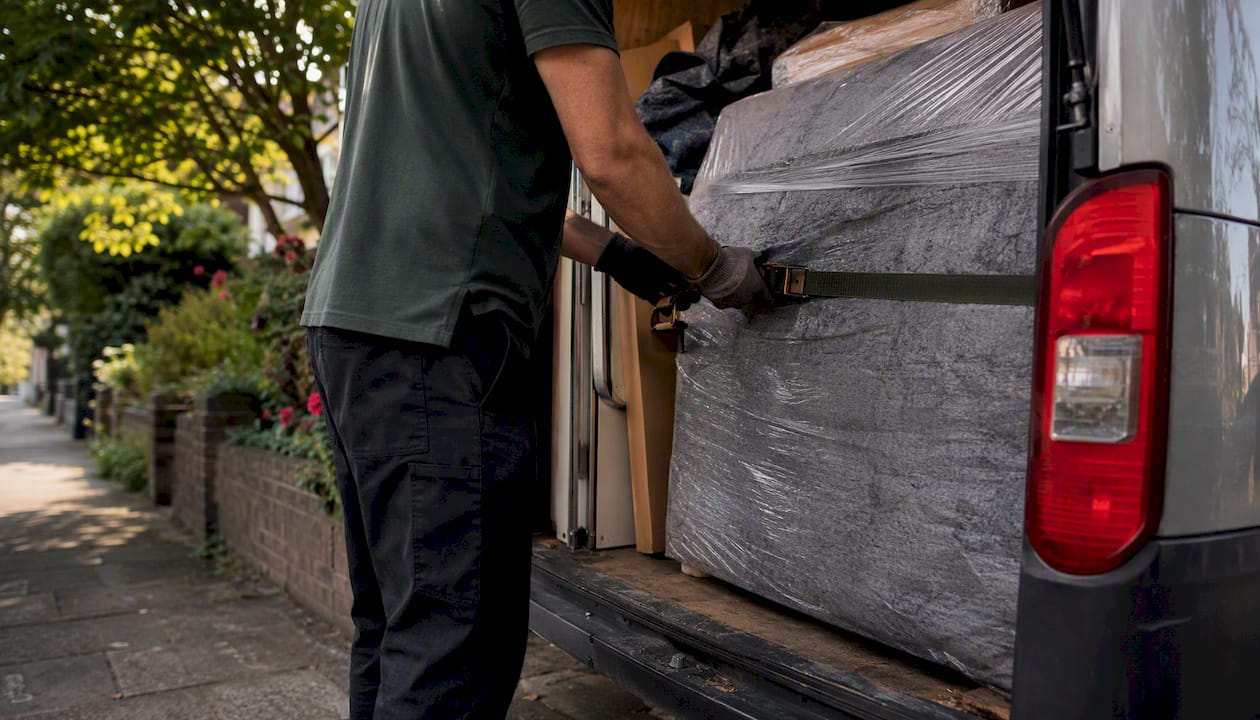
You pick a carrier, pay securely through the app once collection is confirmed, and get a digital duty-of-care receipt as proof the job was done properly. It suits anyone disposing of a heavy, broken or CRT set who wants the reassurance a drop-off point can't offer. Upload a photo of your old TV on Binshare now and compare bids from verified carriers near you.
Frequently asked questions
Can I put a TV in my normal household bin? No. TVs count as WEEE, and UK councils treat them as banned from general rubbish. Use a recycling point, a bulky-item collection, or a licensed carrier instead.
Is TV recycling free in the UK? Drop-off at a recycling centre is usually free. Council collections often carry a small fee, and retailer haul-away is frequently free only when tied to a new TV purchase.
Do charities take old CRT televisions? Rarely. Most charity shops and reuse organisations prefer flat-screen sets in working condition and decline CRTs because of their weight and specialist recycling needs.
What happens to the materials inside a recycled TV? Around 75% of the materials in an old electrical item, including televisions, can be recycled or repurposed according to Recycle Your Electricals, covering metals, plastics and glass components.
How do I get proof my TV was disposed of legally? Ask your council or retailer for a collection receipt, or book through a platform like Binshare, which issues a digital duty-of-care receipt for every completed job.